Rewind Is Not a Cure
Jesse Armstrong's 44-minute marriage autopsy is the best thing in Black Mirror's first series, and its gadget is now a feature you can switch on in Windows settings.
Laptops can already replay your screen and a cheap wristband will transcribe your day; only the implant behind the ear, recording what you see, remains science fiction.
The happiest person at the dinner party is the one who was robbed.
Her name is Hallam (Phoebe Fox), and about a year ago someone cut the recording implant out from behind her ear, probably to order. In this world nearly everyone has a "grain", a device the size of a grain of rice that records everything they see and hear, ready to be replayed in their eyes or on the telly. Hallam's was "gouged". She doesn't remember the attack, she has no brain damage, and after a few days she decided not to get another. She says she's happier. The table treats this the way a table in 2011 would have treated someone who'd given up their phone: as charming, and slightly mad.
Watch the episode again and that's the line it hangs on. Everyone else at the table is holding on to everything. Hallam let go, and she's the only one who seems to be enjoying her dinner.
The episode: Othello with a remote control
"The Entire History of You" aired on Channel 4 on 18 December 2011, closing Black Mirror's first series. It's the only episode of that series Charlie Brooker didn't write. Jesse Armstrong did, years before Succession, and you can already hear him: the dinner-party talk where every joke is also a small act of aggression, the men doing status with their teeth.
Liam Foxwell (Toby Kebbell) is a lawyer who has just had an appraisal go badly, and he can't stop re-doing it, scrubbing back and forth through his bosses' faces for signs of what they really thought. Then he arrives late to a party where his wife Ffion (Jodie Whittaker) is laughing a little too hard at the jokes of Jonas (Tom Cullen), an old friend just out of an engagement, who cheerfully tells the table he spent the end of his last relationship rewatching better nights with earlier girlfriends. By the morning, Liam has grilled the babysitter about whether a joke was actually funny. By the evening, he's demanding his wife show him her memories.
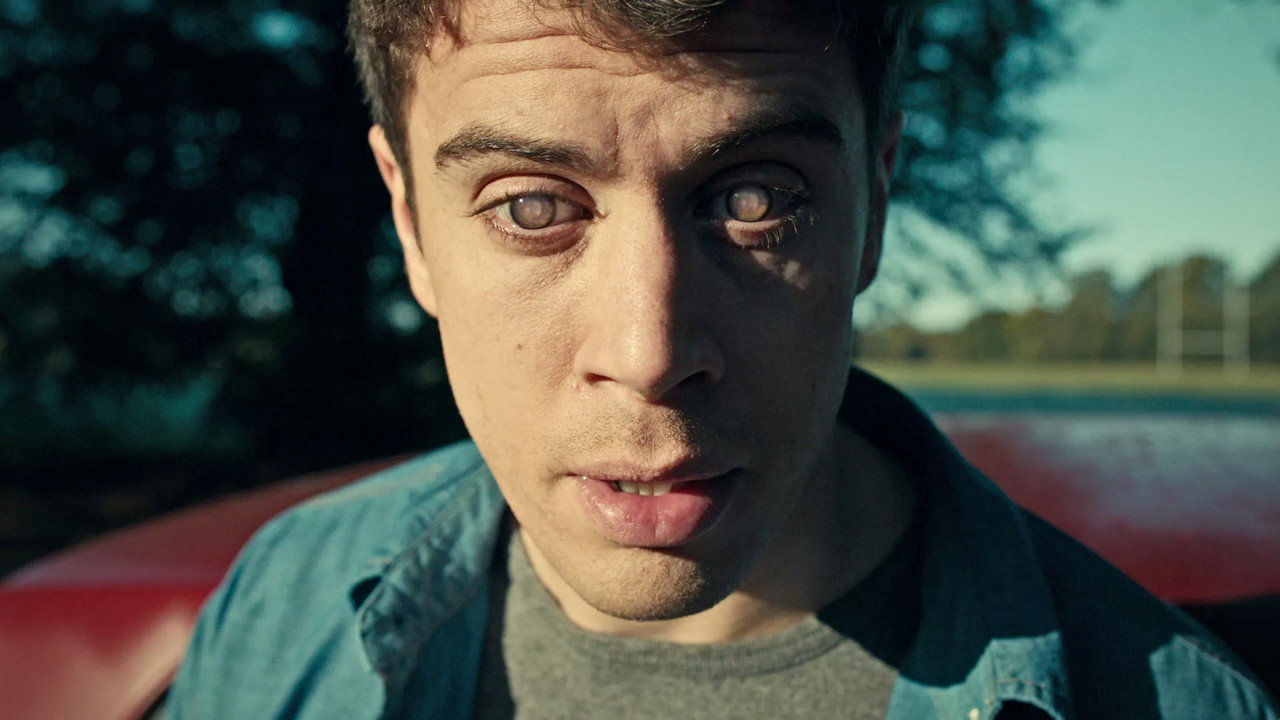
Kebbell is extraordinary, and it's a performance that could easily have gone wrong. Liam is jealous, controlling and drunk, and the episode is honest enough to make him unpleasant without making him a monster. The tell is the eyes. When the characters replay memories, their irises go milky, and Brian Welsh, directing, keeps coming back to Kebbell's face lit by a recording only he can see. He looks less like a man remembering than a man being fed. Whittaker, meanwhile, has the harder job: playing someone whose secret is real, and who knows exactly how the night will end, long before he does.
The production design is a quiet marvel. The houses are timber, stone and steel, not chrome; the "pebble" remote is a smooth little object you'd find on a beach. The future here looks expensive and tasteful, like a nice Sunday-supplement kitchen. That's the point. The horror doesn't come from the machine. It comes from a marriage that has been given a perfect archive.
If there's a flaw, it's a late one. The final act, in which a drunk Liam makes Jonas wipe his footage of Ffion, a vodka bottle doing the persuading, then finds what he was looking for at home, is a shade more thriller than the episode needs. The confession scene is shattering. The coda, Liam alone in the empty house with a razor blade, is as bleak as anything the show did. Getting there involves a car crash that feels like a plot mechanism doing its job. A small thing. It's the gap between 8.5 and 9.
The prophecy: the grain is a feature now
In 2011, the comparison critics reached for was Google Glass. That turned out to be the wrong gadget. The grain arrived in pieces, and the first piece was software.
In April 2025 Microsoft started rolling Recall out across its Copilot+ PCs: a Windows feature that takes snapshots of your screen as you work, stores them on the machine and lets you search your own past by describing it. It's Liam's re-do, for spreadsheets. A month later Signal switched on a setting by default on Windows 11 that blocks Recall from capturing its chats, saying Microsoft had left it no other option. The first big fight over a memory machine wasn't between a husband and wife. It was between two apps, over who gets to remember a conversation.
The second piece was hardware you wear. In July 2025 Amazon agreed to buy Bee, which made a $49.99 wristband that listens to your day and turns it into summaries and transcripts. In December 2025 Meta bought Limitless, maker of an AI pendant that recorded conversations, and stopped selling the pendant to new customers. Not everyone wanted one. Humane's AI Pin was dead within a year of launch, its assets sold to HP for $116 million. But the direction of travel is clear. Recording your life is becoming a default, and the record lives with a tech company.
The third piece is the scene everyone forgets. Early on, at airport security, Liam is made to replay his last 24 hours, then his last week, for an official. In the 2025 fiscal year, US Customs and Border Protection searched the electronic devices of 55,318 international travellers. That's a tiny fraction of arrivals, but the principle is settled: at the border, your recorded past can be inspected.
What hasn't come is the implant itself. Brain-computer interfaces exist. Neuralink's patients move cursors with their thoughts, and researchers have built implants that turn attempted speech into text. Nothing records what you see and hear from inside your head, and there's no credible path to it within 15 years. We didn't need one. The phone, the glasses and the operating system got there first.
And here's what Armstrong saw that the engineers didn't. Every pitch for a memory machine promises the truth: no more arguments about who said what. "The Entire History of You" understood that a perfect record doesn't end the argument. It makes the argument endless. Liam doesn't stop at the truth, because there's always another clip. The archive doesn't make him certain. It makes him a prosecutor in his own house, and nobody wins a case like that.
The reading
Robert Downey Jr's company bought the film rights in 2013. Armstrong later said the project was in development hell, and it never got made. That's probably for the best, because the episode is already complete: 44 minutes, a dinner party, a marriage and a razor. It's the most tightly written thing Black Mirror has made, and the one whose central idea has aged best. In the period when phones first learned to remember everything for us, it was the clearest warning anyone had written about what we'd lose. The ability to forget turned out to be a kind of privacy, and one of the kindest things two people could give each other. Hallam knew. She was the only one at the table who'd lost it and come out ahead.
What it predicted, and what happened
Searchable replay of your own past and official inspection of your recorded life are both here, and wearables that log your day are on sale from Amazon and Meta. The one thing that hasn't come is the implant: the record lives on devices and servers, not behind your ear.
-
EHOY-1
Ordinary people wear a device that continuously records what they hear and see, so their day can be replayed later.
Always-listening wearables that transcribe and summarise your day are on sale, and Amazon and Meta both bought makers of them in 2025. They mostly capture audio rather than continuous video, and the category has had public failures, notably Humane's AI Pin. Continuous audio-and-video lifelogging as a mainstream habit is the remaining step. 123
-
EHOY-2
People can search and replay a complete record of their own recent past instead of relying on memory.
Microsoft's Recall, which snapshots the screen and makes it searchable, rolled out across Copilot+ PCs in 2025 after a year of privacy delays. It covers what happens on a computer, not life itself, and other software is already fighting it: Signal blocks Recall from capturing its chats by default. 456
-
EHOY-3
Officials at the border can make travellers show them their recorded recent past.
US border officers search travellers' phones and laptops under their border search authority, and the numbers have risen steadily since CBP began publishing them. It is still a tiny fraction of arrivals, and 'advanced' searches need reasonable suspicion under CBP policy, but the principle that your recorded life can be inspected at the border is settled. 78
-
EHOY-4
A small implant behind the ear records everything a person sees and hears and plays it back into their eyes.
Brain implants now let paralysed patients move cursors and turn attempted speech into text, but they decode intentions from a few brain regions. Nothing records full sensory experience from inside the head or writes it back to the visual system, and no lab has a credible route to doing so. External devices are doing the job instead. 910
- FOR Amazon acquires Bee, the AI wearable that records everything you say. TechCrunch, 2025-07-22. Amazon agrees to buy the maker of a $49.99 wristband that listens to conversations and produces summaries.
- FOR Meta acquires AI device startup Limitless. TechCrunch, 2025-12-05. Meta buys the maker of a conversation-recording AI pendant to fold into its wearables division.
- AGAINST Humane's AI Pin is dead, as HP buys startup's assets for $116M. TechCrunch, 2025-02-18. The most hyped AI wearable was discontinued within a year, a sign consumer demand is far from settled.
- FOR Microsoft rolling Windows Recall back into Copilot+ PCs. The Register, 2025-04-11. Recall begins general rollout after its 2024 launch was pulled over privacy concerns.
- AGAINST By Default, Signal Doesn't Recall. Signal, 2025-05-21. Signal Desktop turns on a screen-security setting by default on Windows 11 so Recall cannot capture its chats.
- CONTEXT Signal signals discontent with Microsoft Recall. The Register, 2025-05-22. Independent report on the first fight between apps over who gets to remember a conversation.
- FOR CBP Releases Statistics on Electronic Device Searches. U.S. Customs and Border Protection, 2017-04-11. 14,993 arriving travellers had devices searched in the first half of fiscal 2017.
- FOR Border Search of Electronic Devices at Ports of Entry. U.S. Customs and Border Protection, 2026-08-04. 55,318 travellers had devices searched in fiscal 2025, under 0.01% of arrivals; advanced searches require reasonable suspicion.
- CONTEXT PRIME Study Progress Update — User Experience. Neuralink, 2024-05-08. The leading consumer-facing implant company's first patient uses it to control a computer, not to record experience.
- CONTEXT A high-performance speech neuroprosthesis. Nature, 2023-08-23. State of the art in decoding: an implant turning attempted speech into text, far short of recording sight and sound.
Ledger updated 1 Nov 2026. See it on the Nearness Board · Method