The Algorithm Wants You to Run
Black Mirror's sweetest romance is also its slyest advert, and the dating apps have spent the years since trying to build its last scene.
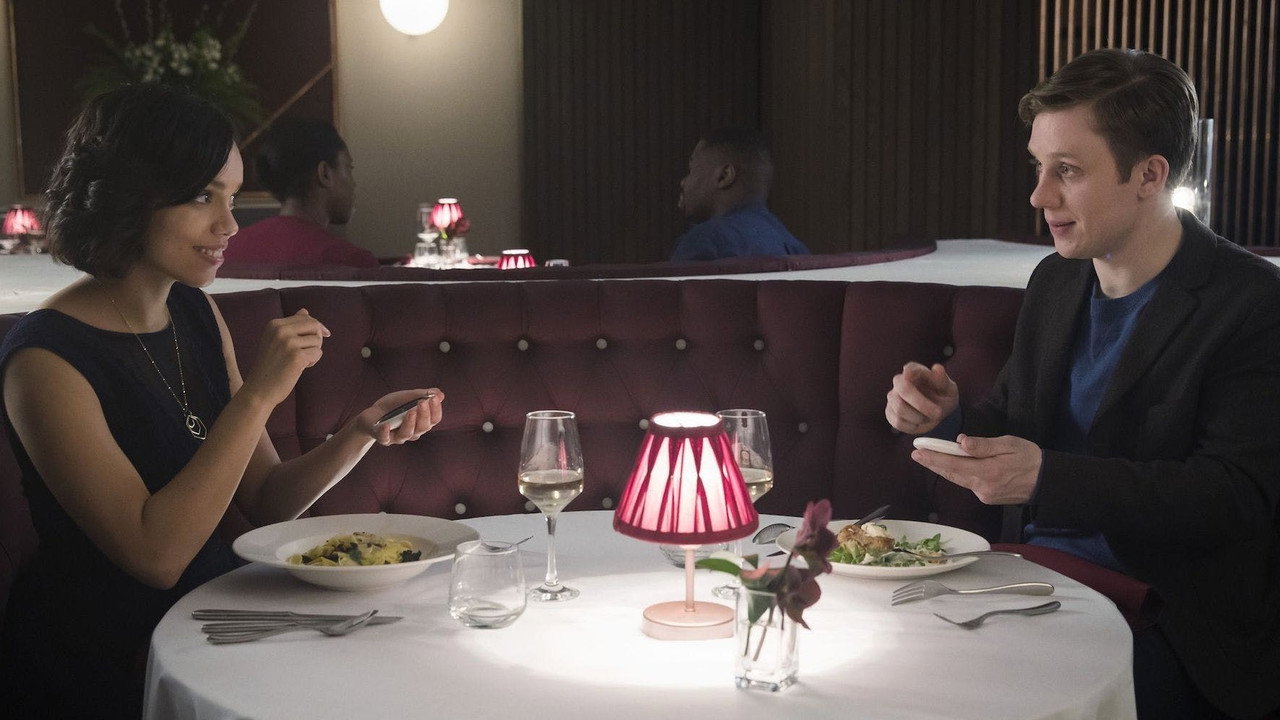
Apps already hand you a few chosen matches and their founders openly pitch AI stand-ins that date on your behalf, but nobody can yet predict a spark, let alone at 99.8%.
Amy skims a stone across the lake. It bounces four times. She skims another. Four again. Every stone, four bounces. It's the best moment in the episode: a woman in love noticing that the world she's in is slightly too tidy, in the way a game is tidy.
"Hang the DJ" is Black Mirror's romcom, released on Netflix on 29 December 2017 as part of the fourth series. Charlie Brooker wrote it; Tim Van Patten directed. It's 51 minutes long. Its title comes from "Panic" by the Smiths, which plays over the final scene, and it was the episode that let people who'd been put off by the show's cruelty tell their friends that this one, honestly, was lovely. It is lovely. It's also the most cunning piece of product placement Brooker ever wrote, for a product that didn't exist yet.
The episode: a playlist of people
Amy (Georgina Campbell) and Frank (Joe Cole) live in a walled, landscaped village where a small round device called Coach assigns them partners, each with an expiry time. Their first date is 12 hours long, and they spend it nervously liking each other. Then Coach sends them on their way. Frank gets a year with Nicola (Gwyneth Keyworth), who visibly despises him. Amy gets nine months with Lenny (George Blagden), a pleasant man who exhales through his nose in a way she comes to find unbearable, followed by a string of 36-hour flings that Van Patten cuts into a numb montage of bodies. Everyone obeys, because the system promises that at the end of it, on pairing day, they'll be given their ideal partner, with a 99.8% success rate.
Brooker has said Coach's run of relationships was modelled on a Spotify playlist, and the episode has the logic of a shuffle: the system plays you a sequence, and you're not supposed to skip. When Amy and Frank are matched again, they agree not to look at their expiry time. Frank looks. It says five years, and then, because he looked, it recalibrates to 20 hours. He confesses with an hour left. Campbell plays Amy's fury at him beautifully, and Cole, all apology and hunched shoulders, is the most likeable man Black Mirror has ever put on screen.
The two of them carry the episode completely. Their chemistry is the kind you can't fake, which is the joke, since the episode is about whether it can be calculated. The landscape helps too: the exteriors were shot at Painshill, an 18th-century landscape garden in Surrey, all follies and still water, a place built to look natural by people who controlled every tree. Alex Somers' score, with two Sigur Rós tracks, is gentle enough to make the menace easy to miss.
Then the twist. Amy and Frank run for the wall, climb it, and the world dissolves. They were simulations, one pair of a thousand. In 998 of the runs, the simulated couple rebelled against the system to be together. Cut to a bar in the real world, where the real Amy and the real Frank look up from their phones at each other. Their dating app says: 99.8% match. "Panic" kicks in. Everyone cries.
It's a great ending, and a cheat. Everything that made the simulated romance moving, the scarcity, the risk, the defiance, turns out to have been a test run for an app recommendation. The episode doesn't seem to notice how dark that is. The app has measured love by counting how often you would smash its own rules to get to someone. Rebellion is the metric. Defiance is just more training data. That's the most Black Mirror idea in the whole episode, and it's delivered as a happy ending. That's the gap between a very good episode and a great one: it's too charmed by its own twist to see what it means.
The prophecy: the apps took the hint
Watch "Hang the DJ" now and the remarkable thing is how much of Coach has come true.
Start with the curating. In July 2018 Hinge launched "Most Compatible", a daily pick chosen by a version of the Gale-Shapley stable-matching algorithm, a method from 1962 for the "stable marriage problem". Instead of browsing, you were handed someone. In November 2025 Tinder began testing Chemistry, an AI feature in New Zealand and Australia that asks you questions and, with permission, studies your camera roll to show you fewer, supposedly better matches. Coach, without the wall.
Then the twist itself. In May 2024 Whitney Wolfe Herd, Bumble's founder, told a Bloomberg conference that in future your AI "dating concierge" could go and date other people's concierges for you, sparing you the bad first dates. The audience laughed. That is, almost exactly, the last five minutes of the episode: copies of you, tested against copies of others, so the real you only meets the winner. And the copies are getting better. In late 2024 a Stanford-led team built AI agents from two-hour interviews with 1,052 Americans; on a standard social survey the best of them reproduced people's answers 86% as well as those people reproduced their own answers two weeks later.
What hasn't come, and may never, is the number. In 2017 three psychologists, Samantha Joel, Paul Eastwick and Eli Finkel, fed more than 100 measures about speed-daters into a machine-learning model. It could predict who was generally desirable, and who generally desired others. It couldn't predict the unique attraction between two particular people at all. Eastwick suggested romantic desire might be more like an earthquake than a chemical reaction. The 99.8% in the episode is the one figure the apps can't sell you, and the one that every one of their adverts implies.
The reading
"Hang the DJ" is the warmest thing Brooker has written and among the best acted. As art it's a lovely, light hour with a final twist that's far darker than it lets on. As prophecy, it's eerily good on the machinery: curated matches, copies of people standing in for us, a system confident it knows us better than we do. It's wrong only about the promise. The apps can now pick for you, coach you and simulate you. They still can't tell you who'll make you laugh across a table. The simulated Amy noticed the stones always bounced four times. The real one, in the bar, just has to take the app's word for it.
What it predicted, and what happened
The machinery of Coach has largely arrived: apps now pick matches for you, and AI copies of people are getting good enough that founders pitch them as dating stand-ins. What hasn't arrived, and may be impossible, is the episode's 99.8%: research suggests the spark between two particular people can't be predicted in advance.
-
HTDJ-1
A dating system chooses your partners for you, rather than leaving you to browse.
Hinge's Most Compatible, launched in 2018, hands each user a daily algorithmic pick, and Tinder's Chemistry, tested from late 2025, promises fewer, more compatible matches chosen by AI. Users can still browse and still say no, so this is Coach as a suggestion rather than a rule. 123
-
HTDJ-2
AI stand-ins for people go on trial dates with each other so the humans only meet the best match.
Bumble's founder publicly pitched AI dating concierges that date other concierges on your behalf in 2024, to widespread scepticism. No major app offers agent-to-agent dating yet. The technology to build crude versions exists; whether anyone will trust it with their love life is the open question. 45
-
HTDJ-3
Software can simulate a specific individual well enough to predict how they will behave.
AI agents built from two-hour interviews reproduced 1,052 people's survey answers about 85% as well as the people reproduced their own answers two weeks later. That is attitudes on a questionnaire, not behaviour in a relationship, and attraction in particular has resisted prediction. 67
-
HTDJ-4
A matching algorithm can predict a lasting couple with near-certainty, around 99.8%.
The best evidence says pairwise romantic chemistry is largely unpredictable from what you can measure before people meet. Apps report better first-meeting rates for their curated picks, which is a long way from predicting who stays together. This may never be possible. 89
- FOR Hinge employs new algorithm to find your 'most compatible' match. TechCrunch, 2018-07-11. Hinge launches a daily recommended match chosen with a version of the Gale-Shapley stable-matching algorithm.
- FOR Match-owned Hinge dating app uses 'stable marriage' AI algorithm for its matches. 9to5Google, 2018-07-12. Independent report of the launch and its stable-marriage algorithm.
- FOR Tinder's AI can find better matches by scanning your camera roll. The Verge, 2025-11-06. Tinder tests Chemistry, an AI matching feature that learns from questions and, with permission, the camera roll.
- FOR AI personas are the future of dating, Bumble founder says. Many aren't buying.. NBC News, 2024-05-10. Whitney Wolfe Herd describes AI dating concierges dating each other for users; reports public scepticism.
- FOR Bumble's Whitney Wolfe Herd says AI could date 'hundreds' of people for you. Fortune, 2024-05-10. The same Bloomberg Tech remarks, with the pitch that concierges spare users from talking to hundreds of people.
- FOR LLM Agents Grounded in Self-Reports Enable General-Purpose Simulation of Individuals. arXiv (Park et al.), 2024-11-15. Agents of 1,052 real people reach 83-86% of participants' own test-retest consistency on the General Social Survey.
- AGAINST Romantic Matches Are Hard to Predict Before People Meet. Association for Psychological Science, 2017-08-30. Machine learning predicted general desirability but not unique attraction between two people.
- AGAINST Romantic Matches Are Hard to Predict Before People Meet. Association for Psychological Science, 2017-08-30. Joel, Eastwick and Finkel's model, using more than 100 predictors, could not forecast unique desire between specific pairs.
- CONTEXT Hinge employs new algorithm to find your 'most compatible' match. TechCrunch, 2018-07-11. Hinge's own claim was that Most Compatible picks were 8x more likely to exchange numbers, a measure of first contact, not lasting love.
Ledger updated 1 Nov 2026. See it on the Nearness Board · Method