Next Year in Bexhill
Alfonso Cuarón's film is set in 2027, which is now next year. It got the babies wrong and almost everything else right, and it's still the best-made film in our archive.
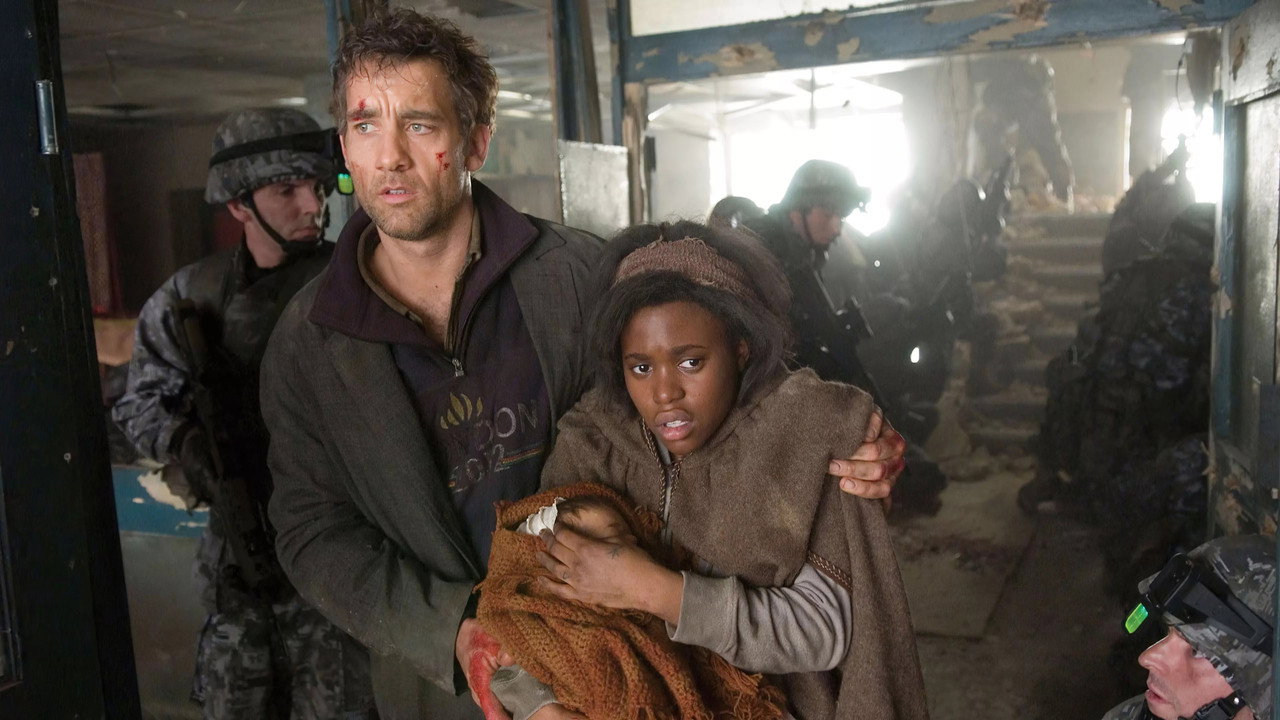
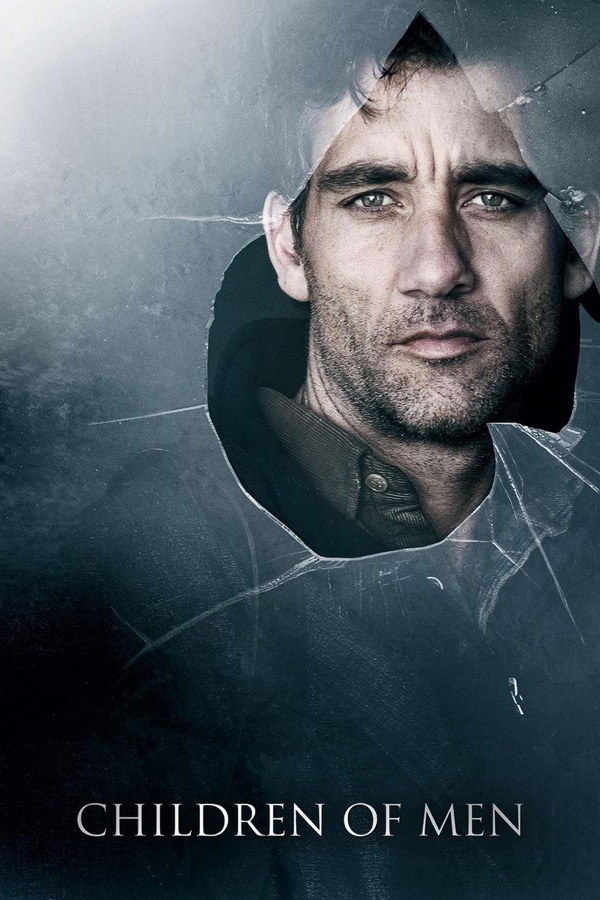
Children are still being born, but the falling birth rate is now a national emergency in Seoul and the camps, barges and offshore schemes for asylum seekers became ordinary British politics.
Children of Men is set next year.
That sentence used to be a piece of trivia. Now it's a deadline. Cuarón put his collapsed Britain in 2027, and the film opens with a news bulletin: the youngest person on Earth, an 18-year-old known as Baby Diego, has been stabbed outside a bar in Buenos Aires. A café full of Londoners watches the screen in tears. Theo Faron, played by Clive Owen as a man who has stopped expecting anything, buys his coffee, walks out onto Fleet Street, and the café explodes behind him.
The camera doesn't cut. It hasn't cut since the film began. That's the first thing you notice about Children of Men, and it's the thing everybody writes about. It's also not quite true, which is the first clue to what's really going on.
The art: the long take as a moral position
The famous single shots are composites. The visual effects team at Double Negative stitched several takes together with "seamless" digital transitions. The opening café shot was filmed over two consecutive days. The car ambush on the country road was shot in six sections at four locations over a week, with a custom rig built by Doggicam so the camera could glide around the inside of the car while actors' seats tilted out of its way. The six-minute battle through the Bexhill refugee camp was captured in five takes over two locations. Cuarón has admitted that "sometimes it's more than what it looks like."
None of this matters, and all of it does. What the long take does is refuse you the edit, the moment where a normal action film lets you breathe, look away, see the hero from a safe angle. Cuarón and his cinematographer, Emmanuel Lubezki, keep you at Theo's shoulder, so the violence happens beside you rather than in front of you. When blood splattered onto the lens during the battle sequence, Lubezki talked Cuarón into keeping it. It stays there for the rest of the shot, a smear on your own glasses. That's what the trick is for. It makes you a witness, and witnesses can't change the channel.
Cuarón told his art department the film was the "anti-Blade Runner". No flying cars, no neon, no gleaming towers. The future is the present, a bit dirtier, with the bins not collected. He dressed East London to look poorer, and the Shard is digitally added to the skyline because it would, he reasoned, have been built by then. Theo wears a faded London 2012 sweatshirt. Battersea Power Station has become a state art archive, with Michelangelo's David and Picasso's Guernica among the rescued works, and a pig balloon floating outside as a nod to Pink Floyd. Theo's cousin runs this "Ark of the Arts". When Theo points out that in a hundred years there will be no one left to look at any of it, the cousin says he just doesn't think about it.
The film is full of these background details, and the background is where the argument lives. TV screens announce Day 1,000 of the siege of Seattle. Government adverts tell you that hiring, feeding or sheltering an illegal immigrant is a crime. Refugees sit in roadside cages. A sign over the camp at Bexhill reads "Homeland Security". The rations come with antidepressants and Quietus, a suicide kit with a soothing advert. Michael Caine, as Theo's old friend Jasper, a retired political cartoonist growing weed in the woods, is the only person in the film still having fun, and he has to be killed to make the point that fun is over.
Is there a weakness? A small one. Kee, played by Clare-Hope Ashitey, is the first pregnant woman in eighteen years, and the script gives her less interior life than it gives the farm animals. She's funny and frightened and the film is moved by her, but she is mainly cargo, and the Nativity symbolism (the barn, the cries of "Jesus Christ") leans on her harder than she can bear. The Fishes, the militant group who want her baby as a political symbol, are motivated by plot rather than belief. These are the only places where the film's machinery shows. Everywhere else it's flawless.
The prophecy: the babies were the metaphor
As a forecast of fertility, the film is wrong, and it was never trying to be right. The cause of the infertility is never explained, on purpose. Cuarón has described it as a metaphor for a fading sense of hope. Even so, reality has shuffled closer than anyone expected. A large 2022 meta-analysis found that sperm counts among unselected men roughly halved between 1973 and 2018. South Korea's fertility rate fell to 0.72 in 2023, and its president called the birth rate a "national crisis" and promised a new ministry to deal with it. The UN now expects the world's population to peak in the mid-2080s and then start falling. Babies are still being born, millions of them. But the idea of a nation looking at its maternity wards and seeing a security problem is no longer fiction.
The real hit is the border. In 2006, a Britain that hunts asylum seekers "like cockroaches", as Jasper puts it, keeps them in camps and bans its citizens from helping them was meant to feel like a warning. Seventeen years later Parliament passed the Illegal Migration Act 2023, placing a duty on the Home Secretary to remove people who arrive irregularly and widening the powers to detain them. The government spent years trying to fly asylum seekers to Rwanda until the Supreme Court ruled the plan unlawful in November 2023. From August 2023, asylum seekers were housed on the Bibby Stockholm, a barge moored in Portland harbour in Dorset, until the last of them left in November 2024. None of this is Bexhill. There are no machine guns on the promenade. But the film's essential claim is that a frightened country will make refugees the place where it stores its fear, and that was a forecast, not a mood.
Even Quietus has edged closer. Canada provided medically assisted deaths to 15,343 people in 2023, about 4.7% of all deaths, and 622 of them to people whose death was not reasonably foreseeable. In November 2024 MPs voted by 330 to 275 to back a bill to legalise assisted dying for terminally ill adults in England and Wales. None of this is an advert on the Tube. But the film's line, that a society without a future will start offering its citizens a dignified exit, now reads as a policy debate rather than a nightmare.
And one throwaway detail lands like a slap. Theo and Julian's son, Jasper tells Kee, died in a flu pandemic in 2008. The film came out in 2006. In 2009 there was a flu pandemic.
The reading
Children of Men is the best film we've reviewed. It's a chase thriller, a Nativity play and a documentary about the year after next, and it never stops moving long enough to lecture you. As prophecy it got the cause wrong and the consequences right, which is the better way round. In 2027 the babies will still come. The camps, the barges, the fear dressed as procedure: those came early. The film ends with a small boat at sea and the sound of children laughing. It's the most hopeful ending of any dystopia, and the hope arrives the way it does in real life, on a rowing boat, without papers.
What it predicted, and what happened
With its setting a year away, Children of Men has missed its central premise: babies are still being born everywhere. Almost everything around that premise has moved closer. Collapsing birth rates are treated as a national emergency, Britain built its asylum policy around detention, barges and offshore removal, and state-sanctioned assisted death is spreading, though nothing yet looks like Quietus on a ration shelf.
-
COM-1
Human beings stop being able to have children, worldwide, for nearly two decades.
There is no known mechanism for sudden global infertility. Sperm counts among unselected men roughly halved between 1973 and 2018 in a large meta-analysis, which is worrying, but births fell because people chose to have fewer children, not because they couldn't. The UN still expects world population to grow to about 10.3 billion in the mid-2080s before declining slowly. Treat the estimate as a placeholder for 'not on any current path'. 12
-
COM-2
A government treats its falling birth rate as a national emergency and builds state machinery around it.
South Korea's fertility rate reached 0.72 in 2023, the lowest in the world. Its president called the low birth rate a national crisis and planned a new ministry to address it, alongside billions spent on incentives. More than half of all countries now have fertility below replacement, according to the UN. Korea's rate ticked up to 0.75 in 2024, so the emergency is real but not a one-way slide. 345
-
COM-3
Britain detains asylum seekers en masse in camps, barracks or barges and tries to remove them overseas.
The Illegal Migration Act 2023 placed a duty on the Home Secretary to arrange the removal of people who arrive irregularly. Asylum seekers were housed on the Bibby Stockholm barge in Dorset from August 2023 to November 2024, and the plan to send asylum seekers to Rwanda was ruled unlawful by the Supreme Court in November 2023 and later dropped, with opposition politicians promising to revive it. Nothing resembles armed camps on the coast, but large-scale detention and offshore removal are now mainstream policy proposals. The date is for the policy, not the cages. 678
-
COM-4
The state supplies a lethal means of suicide to citizens who choose to die.
Medically assisted death is legal and state-regulated in several countries. Canada provided it to 15,343 people in 2023, about 4.7% of deaths, including 622 whose death was not reasonably foreseeable. MPs in England and Wales backed an assisted dying bill for terminally ill adults in November 2024, and a suicide capsule was promoted for use in Switzerland in 2024. All of these are gated by medical or legal criteria; nothing like the film's Quietus, handed out with the rations and advertised as a consumer product, exists. 91011
- FOR Temporal trends in sperm count: a systematic review and meta-regression analysis of samples collected globally in the 20th and 21st centuries. Human Reproduction Update, 2023. Meta-analysis of 223 studies finds mean sperm concentration among unselected men fell by about 51.6% between 1973 and 2018.
- AGAINST UN projects world population to peak within this century. UN Department of Economic and Social Affairs, 2024-07-11. Population is expected to keep growing to about 10.3 billion in the mid-2080s; fertility is low because of fewer births per woman, not sterility.
- FOR South Korea birthrate rises for first time in nine years amid surge in marriages. The Guardian, 2025-02-26. Reports the president's description of a 'national crisis' and plans for a new ministry, and the rise from 0.72 to 0.75.
- CONTEXT UN projects world population to peak within this century. UN Department of Economic and Social Affairs, 2024-07-11. In more than half of countries fertility is below 2.1, and nearly a fifth, including South Korea, have 'ultra-low' fertility below 1.4.
- AGAINST Korea's birthrate rebounds for 1st time in 9 years. The Korea Times, 2025-01-03. An early sign the decline can reverse, at least slightly.
- FOR Illegal Migration Act 2023. legislation.gov.uk, 2023-07-20. Creates a duty to make arrangements for the removal of people who enter the UK irregularly, with wider powers of detention.
- FOR Bibby Stockholm: First asylum seekers board housing barge in Dorset. BBC News, 2023-08-07. Asylum seekers move onto a barge moored at Portland Port despite local protests.
- AGAINST Supreme Court rules Rwanda asylum policy unlawful. BBC News, 2023-11-15. The courts blocked the offshore removal plan, showing the legal limits on the film's Britain.
- FOR Fifth Annual Report on Medical Assistance in Dying in Canada, 2023. Health Canada, 2024-12-11. 15,343 MAID provisions in 2023, about 4.7% of deaths; 622 were for people whose natural death was not reasonably foreseeable.
- FOR MPs back proposals to legalise assisted dying. BBC News, 2024-11-29. The Commons voted 330 to 275 at second reading for a bill covering terminally ill adults expected to die within six months.
- CONTEXT Suicide capsule to be used in Switzerland this year, says euthanasia organisation. swissinfo.ch, 2024-07-17. A group promotes the Sarco capsule as a death 'at the push of a button' without doctors, unlike established Swiss assisted-suicide groups.
Ledger updated 1 Nov 2026. See it on the Nearness Board · Method