The Statue Doesn't Move
Alex Garland's quantum-computer miniseries is the most beautiful thing on this list and the most inert. Its machine is impossible, but its tech campus is exactly right.
The quantum hardware, the behaviour-predicting models and the secretive, messianic lab are partly here; the machine that replays history is ruled out by physics.
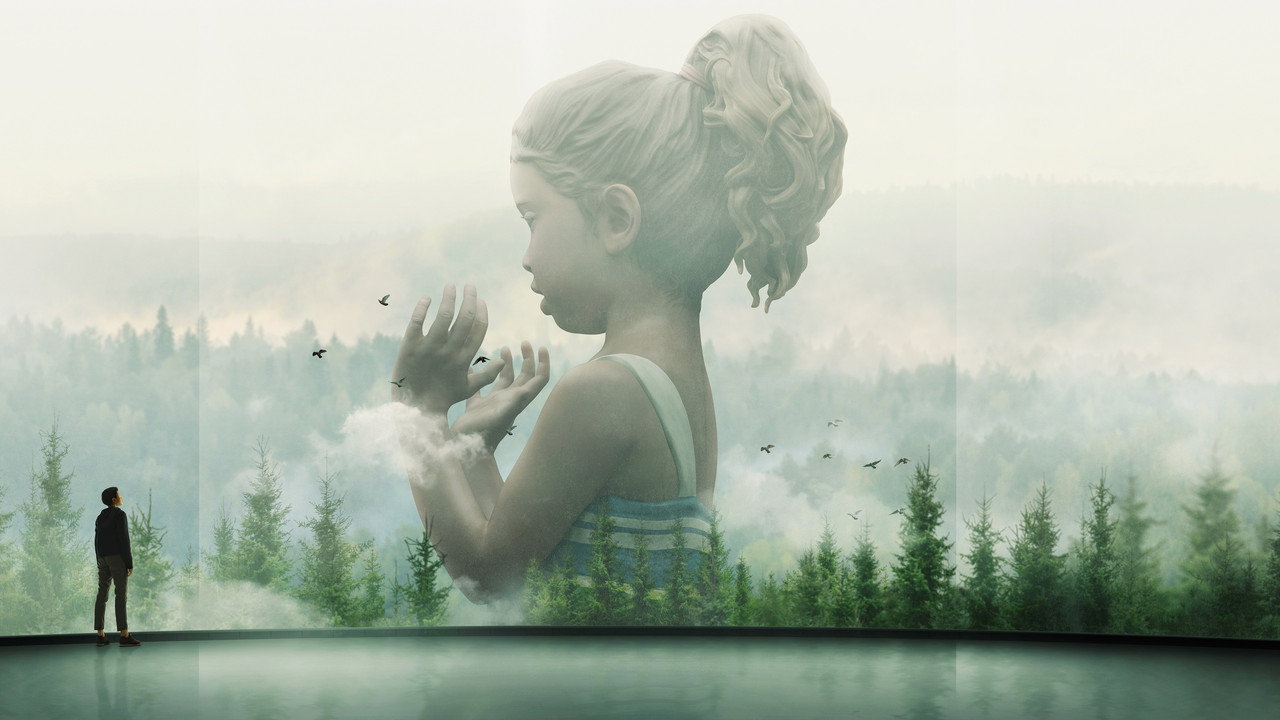
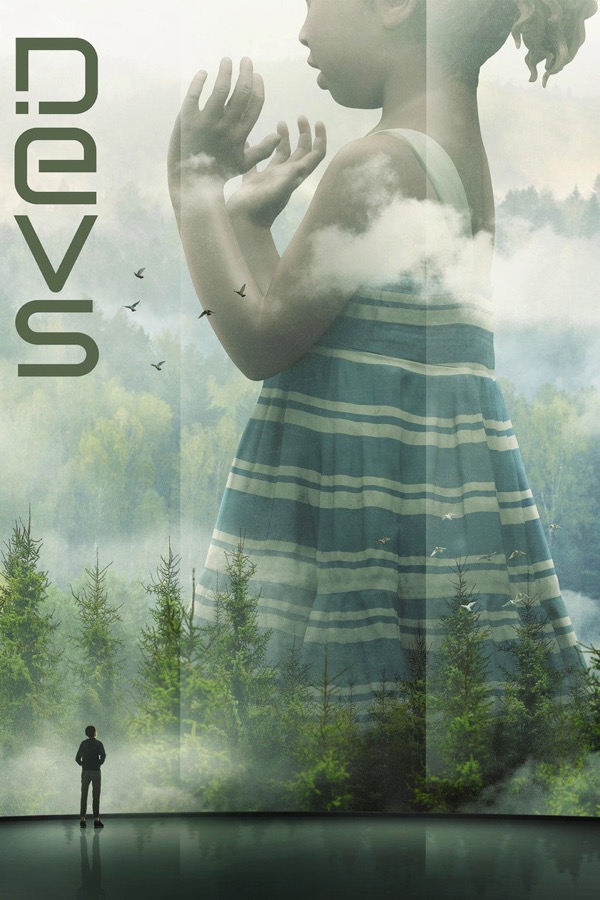
Above the redwoods on the Amaya campus stands a statue of a little girl, several storeys high, cupping her hands as if she's about to catch something. She's Forest's dead daughter. You can see her across the campus, from the woods and from the windows of the offices where the company's best engineers write code. She is the most striking image in Devs, and she never does anything. She stands there, enormous and grieving and perfectly lit, for eight episodes.
That's the show. Devs is gorgeous, serious and almost entirely static. It has the production values of an art installation and the pacing of one, and like the statue it's easier to admire than to love.
The art: eight hours inside a gold-lined box
Alex Garland created, wrote and directed every episode. FX on Hulu released it from 5 March 2020, as much of the world was about to lock down, and BBC Two showed it in the UK from April. Garland had already made Ex Machina and Annihilation. Devs is the purest form of his style yet: cold symmetry, long silences, a few faces lit from below and a lot of choral music.
The story starts as a thriller. Lily Chan (Sonoya Mizuno) is a software engineer at Amaya, a quantum computing company in the San Francisco Bay Area. Her boyfriend Sergei (Karl Glusman) is promoted into Devs, the secret division run by the founder, Forest (Nick Offerman). On his first day he's caught spying for Russia, and the company's security chief, Kenton (Zach Grenier), kills him and makes it look like suicide. Lily doesn't buy it. She turns to her ex, Jamie (Jin Ha), and starts pulling at the thread.
What Devs is actually building, it turns out, is a machine that can calculate the past and future from the present state of the universe. Forest believes the universe is deterministic, every event following from the one before like a tram running on its lines, and the machine proves it. The Devs team watch a projection of the crucifixion. They listen to Lincoln at Gettysburg. And the future goes dark at a certain moment, a moment that involves Lily.
There is a great show in this. Offerman, bearded and gentle and coiled, is excellent as a grieving man who has built a theology out of physics so he doesn't have to feel guilty about his daughter's death. Alison Pill is chilling as Katie, the lead designer, who believes in the tram lines so fully that she lets a colleague die. Cailee Spaeny's Lyndon is the brightest spark in the lab. She gets the projections working by switching to a many-worlds model, is fired for it, and later stands on the edge of a dam to test her faith in the theory. Stephen McKinley Henderson, as the poetry-quoting Stewart, gets the best lines and the final act of sabotage.
The trouble is that Devs explains its ideas far more than it dramatises them. Characters stand in beautiful rooms and tell each other what determinism means. Mizuno is given a protagonist with very little inner life. Lily is less a person than a variable the machine can't solve, and the show treats her blankness as mystery. The thriller plot, with Russian agents and a security chief who kills when told to, is so thin that it seems to embarrass the show. It mostly disappears.
Then the ending. Lily throws away a gun when the machine has predicted she'll fire it, breaking determinism with a single choice. Stewart drops the capsule anyway. Lily and Forest wake up inside the Devs simulation, where Forest's daughter is alive. It's a bold idea, a Silicon Valley heaven that runs on the company's servers, delivered with all the force of a press release. Critics split on whether it landed. For me it's a shrug in a cathedral.
Rob Hardy's photography, the score by Ben Salisbury, Geoff Barrow and The Insects, and the gold, floating Devs lab are tremendous. The show was nominated for Emmys for its cinematography, sound and visual effects, and you can see why. A 6.4 feels harsh for something this beautiful. But beauty is the easy part of Garland's job, and he did the easy part.
The prophecy: impossible machine, accurate building
The quantum computer. In 2020 this was the shiny part. In December 2024 Google announced its Willow chip, which ran a benchmark in under five minutes that Google says would take a top supercomputer around ten septillion years. It also showed that error correction gets better as you add qubits, the thing that matters for scaling. These benchmarks are chosen to suit quantum hardware and solve nothing anyone needs. When Google claimed supremacy in 2019, IBM argued that a classical machine could do the same job in about two and a half days. Quantum advantage is arriving. It's arriving for problems that don't need a statue.
The time machine. Devs is a machine that rebuilds any moment from the present arrangement of particles. Physicists call that Laplace's demon. Quantum mechanics says you can't copy an unknown quantum state, so you can't read out the present exactly, and it's an open question whether the universe is deterministic at all. This isn't a prediction that is running late. It's probably ruled out.
The prediction engine. The smaller version is closer than the show suggests. In 2025, a model called Centaur, trained on more than ten million choices from 160 psychology experiments, predicted people's decisions better than established theories of how people decide. That's a lab result about lab tasks, and real-world prediction has a poor record. But the instinct behind Devs, that enough data would let you see a person coming, moved from science fiction into a Nature paper.
The campus. This is what Garland got right, and it's the part the show seemed least interested in. Devs is a frontier lab run by a bereaved founder who talks about his work in religious terms, guarded by private security, staffed by true believers bound to secrecy. In 2024 leaked documents showed OpenAI tying departing employees' vested equity to non-disparagement agreements, and current and former staff at the big labs published a letter asking for the right to warn the public about risks. Garland thought the danger in a lab like that would be the machine. It turned out to be the culture around it.
The reading
Devs is a meditation dressed as a thriller, and it isn't quite enough of either. It's worth watching once for Offerman, for Hardy's camera and for the feeling that a major filmmaker is taking big ideas seriously on television. It isn't worth watching for the ideas, which a good physics podcast handles better and faster.
Its real subject is power: a man rich enough to build a machine that tells him his daughter's death wasn't his fault. The machine sees everything except a choice. The statue still hasn't moved.
What it predicted, and what happened
The machine at the centre of Devs, a quantum computer that can watch any moment in history, is not coming, and may be ruled out by physics. The world around the machine is already here: quantum hardware beating supercomputers on narrow tasks, models that predict human choices, and frontier labs run under heavy secrecy by founders their staff treat as prophets.
-
DEVS-1
Quantum computers solve problems that no classical computer can solve in practice.
Google's Willow chip ran a benchmark in under five minutes that Google says would take a top supercomputer around 10^25 years, and it showed error correction improving as qubits were added. Those benchmarks are built to favour quantum hardware and have no practical use. Earlier supremacy claims were disputed by rivals. A useful problem solved beyond classical reach is the threshold still to cross. 123
-
DEVS-2
A computer reconstructs and replays any past or future event by calculating it from the present state of matter.
This is Laplace's demon with a screen, and it may be impossible in principle, not merely hard. Quantum mechanics forbids copying an unknown quantum state, so the exact present state cannot be read out in full. Whether the universe is deterministic at all is an open question in physics and philosophy. The date range here is a formality. The honest answer may be never. 45
-
DEVS-3
Software predicts individual human choices more accurately than our best theories of human behaviour.
Centaur, a language model fine-tuned on more than ten million choices from 160 psychology experiments, predicted held-out participants' behaviour better than established cognitive models. That is a lab result about lab tasks. Prediction in the wild is much worse, as predictive policing tools have shown. 67
-
DEVS-4
Staff at frontier technology labs are bound by sweeping secrecy agreements that stop them speaking about what they build.
In 2024 leaked documents showed OpenAI tying former employees' vested equity to non-disparagement agreements, and current and former staff at leading AI labs published a letter asking for a right to warn the public about risks. Sam Altman apologised and said OpenAI had never clawed back vested equity and would not. The secrecy is real, and it is now being contested in public. 89
- FOR Meet Willow, our state-of-the-art quantum chip. Google, 2024-12-09. Claims a random circuit sampling run in under five minutes that would take a leading supercomputer about 10 septillion years.
- FOR Quantum error correction below the surface code threshold. Nature, 2024-12-09. Logical error rates fall as the surface code grows, the precondition for scaling.
- AGAINST On "quantum supremacy". IBM, 2019-10-22. IBM argued Google's 2019 supremacy task could be simulated classically in about 2.5 days, not 10,000 years.
- AGAINST A single quantum cannot be cloned. Nature, 1982-10. Wootters and Zurek's no-cloning theorem: the linearity of quantum mechanics forbids copying an unknown quantum state.
- CONTEXT Causal Determinism. Stanford Encyclopedia of Philosophy, 2003-01-23. Surveys whether physics supports determinism, including Laplace's demon and quantum mechanics.
- FOR A foundation model to predict and capture human cognition. Nature, 2025-07-02. Centaur, trained on Psych-101 (60,000+ participants, 10 million+ choices), beats existing cognitive models at predicting held-out behaviour.
- AGAINST Predictive Policing Software Terrible At Predicting Crimes. The Markup, 2023-10-02. A crime-prediction product sold to a New Jersey police department was right less than 1% of the time.
- FOR OpenAI NDAs: Leaked documents reveal aggressive tactics toward former employees. Vox, 2024-05-22. Documents show departing staff pressured to sign non-disparagement terms or risk vested equity.
- FOR A Right to Warn about Advanced Artificial Intelligence. righttowarn.ai, 2024-06-04. Current and former OpenAI and Google DeepMind staff ask labs to stop enforcing non-disparagement agreements over risk concerns.
Ledger updated 1 Nov 2026. See it on the Nearness Board · Method