The Eyelash Always Testifies
Andrew Niccol's gorgeous, schematic debut guessed the technology almost exactly and cast the wrong villain. The gatekeeper turned out to be the parents.

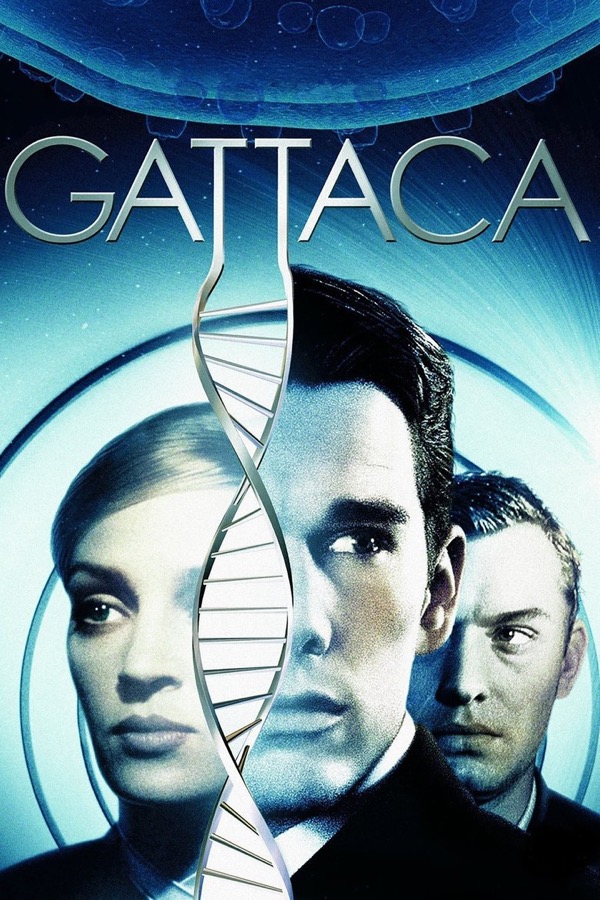
Embryos are already ranked by polygenic score for paying customers and England plans to read every newborn's genome, but the law got to the hiring office before the geneticists did.
In July 2025 the British government published a health plan with a sentence in it that Andrew Niccol could have written. The NHS, it said, would "implement universal newborn genomic testing and population-based polygenic risk scoring." It sat in a bullet list between lung cancer screening and HPV jabs, with no fanfare. Nobody in Whitehall mentioned Gattaca. They didn't need to. Everyone who read the line already had the film in their head: the blood drop on the delivery-room table, the readout, the doctor reciting a dead man's future to a mother holding a baby that is a few seconds old.
That's the strange afterlife of Niccol's first film as a director. It flopped in October 1997, taking about $12.5 million in the US against a reported $36 million budget. It then became the reference point for every argument about human genetics for the next thirty years. Bioethicists cite it in papers. In 1997 the molecular biologist Lee Silver told readers of Nature Genetics that it was a film all geneticists should see, if only to understand how the public saw their trade. It's a film everybody has an opinion about, and fewer people have rewatched.
Rewatched, it holds up as a thing to look at, and it creaks as a thing to listen to.
The art: a beautiful machine with a murder in it
Start with how it looks, because that's where Gattaca is unbeatable. Niccol and his production team set the future in the past. The Gattaca Aerospace Corporation is Frank Lloyd Wright's Marin County Civic Center in San Rafael, a long, low spaceship of a building that was already decades old when they filmed there. The cars are electric, styled on 1960s Rovers, Citroëns and Studebakers, and they hum instead of roaring. Everyone wears good tailoring. The palette is aquarium green and gold. The whole film was nominated for an Oscar for its art direction, and it earns it in every frame. It's a future designed by people who suspected that, once perfection was on offer, the rich would buy the old-fashioned version of everything else.
Michael Nyman's score swells and swoons in the same register. The opening titles, by Michael Riley, are close-ups of fingernails and hairs hitting the floor like falling meteors, oversized models dropped with a thud. You only learn later that they're the skin Vincent scrubs off every morning so the building won't know he's there. It's one of the great title sequences of the decade, and it tells you the film's real subject before a word is spoken. In this world you shed your evidence constantly. Your body informs on you.
Ethan Hawke plays Vincent Freeman, conceived the old way and labelled an "In-Valid" at birth, with a heart defect and a predicted lifespan of 30.2 years. He wants to fly to Titan. The only route is to become a "borrowed ladder", renting the identity of Jerome Eugene Morrow, a genetically engineered swimmer who won silver instead of gold and then threw himself in front of a car. Jude Law plays Jerome, and Law walks off with the film from a wheelchair. Jerome is bitter, funny, drunk and dressed beautifully, a man designed for first place who can't forgive himself for second. Every scene between the two of them is about envy running in both directions. Vincent wants Jerome's body. Jerome wants Vincent's nerve.
Then there's the plot, and the plot is the problem. A mission director is murdered, one of Vincent's eyelashes turns up near the body, and the film becomes a slow police procedural with Alan Arkin and Loren Dean hunting an unregistered In-Valid through a building of pristine valids. It's there to generate tension, and it generates very little, because we know Vincent didn't do it and the real killer is revealed with a shrug. Uma Thurman, as the colleague Irene, is given a heart condition, a lot of meaningful glances and not much else. She is less a character than a mirror held up so Vincent can see how a "valid" with a flaw lives.
What works is the swimming. Twice Vincent races his engineered brother Anton out to sea, and the second time he tells him the secret. "I never saved anything for the swim back." It's the best line Niccol has written, and it's the whole film: a man who can only beat the odds by refusing to budget for survival. The coda, with Jerome climbing into the incinerator wearing his silver medal as the rocket lifts, is overwrought and still lands like a punch.
The prophecy: the right machine, the wrong gatekeeper
Gattaca bet that we'd learn to read embryos, read people from the cells they shed, and sort them by the result. On the technology it was almost exactly right.
Polygenic embryo screening is a product. Companies such as Orchid sell whole-genome tests on IVF embryos with risk scores for "complex conditions like heart disease, breast cancer, diabetes, and schizophrenia." By December 2021 the European Society of Human Genetics was warning that at least one child had already been born after this kind of selection, and calling the practice "unproven" and "unethical", because a polygenic score on an embryo predicts very little. The scan in the delivery room, meanwhile, is becoming national policy. Genomics England's Generation Study is sequencing the genomes of 100,000 newborns, and the 2025 plan treats it as the pilot for doing every baby. Shedding is policing, too. US border agents piloted Rapid DNA kits in 2019 that could settle whether a child was related to an adult in about 90 minutes without human review. The eyelash in the corridor is a reasonable guess at where that goes.
But Niccol aimed his anger at the wrong door. In Gattaca the discrimination is done by employers, quietly, with a urine sample at the turnstile. "We now have discrimination down to a science," Vincent says in voiceover. That's the part that didn't happen. The US passed the Genetic Information Nondiscrimination Act in 2008, making it illegal for employers to use genetic information in hiring. Britain's insurers have agreed not to ask for predictive genetic test results, except for Huntington's disease on life cover over £500,000. The hiring office got a law before it got the technology.
What the film missed is that the sorting didn't need a corporation. It was always going to be done by parents, at the embryo stage, privately, for a fee, with the best of intentions and a consent form. In the mid-2020s the genetic gatekeeper wasn't Gattaca Aerospace. It was a couple at a fertility clinic choosing between five blastocysts on a spreadsheet. Nobody was discriminated against. Some people were just never born. That's a harder villain to put on screen, because there's nobody to fool with a borrowed ladder.
The reading
Gattaca is a beautiful film with a thin thriller bolted on, and a prophecy that got the instruments right and the orchestra wrong. Watch it for Law, for the swimming, for the building and for the fingernails falling like meteors. Then read the 2025 health plan and notice which line made you flinch. The film taught a generation what to be afraid of. The future it warned about arrived anyway. It just came in through the maternity ward instead of the staff entrance.
What it predicted, and what happened
Gattaca got the instruments almost exactly right: embryos are ranked by polygenic score for paying customers, a DNA test can settle identity in about 90 minutes without a lab, and England plans to read every newborn's genome. It got the gatekeeper wrong. Genetic discrimination in hiring was outlawed before it took hold, and the sorting moved to the fertility clinic instead.
-
GAT-1
Parents using IVF can choose between embryos ranked by their predicted genetic risk of common diseases.
Polygenic embryo screening (PGT-P) is sold commercially; Orchid markets whole-genome embryo reports with risk scores for conditions such as heart disease, diabetes and schizophrenia. By December 2021 the European Society of Human Genetics reported that at least one child had been born after such selection. The science is weak: a polygenic score on an embryo predicts little, and geneticists have called the practice unproven. It has arrived as a product, not as the precise forecast the film imagined. 12
-
GAT-2
Employers screen job applicants' DNA and give the best jobs to the genetically favoured.
The law moved first. The US Genetic Information Nondiscrimination Act of 2008 bars employers from using genetic information in hiring, firing or promotion, and the UK insurance industry's code bars insurers from using predictive genetic test results, except Huntington's disease for life cover over £500,000. Genetic sorting has instead moved into reproduction and private testing, where no employer is involved. 34
-
GAT-3
Officials can confirm who someone is from a DNA sample in about the time it takes to pass a checkpoint, without a laboratory.
Rapid DNA instruments produce a profile in under two hours with no human interpretation and can be run by non-specialists in the field. In 2019 US immigration authorities piloted them at the Mexican border to test whether children were biologically related to the adults with them, with results in about 90 minutes. Using them on degraded traces like a single shed eyelash at a crime scene remains harder and more restricted. 56
-
GAT-4
Every newborn's genome is read at birth and used to predict their risk of disease.
Genomics England's Generation Study is sequencing the genomes of 100,000 newborns to look for more than 200 rare conditions, and the government's 2025 health plan commits to universal newborn genomic testing and population-wide polygenic risk scoring. The plan sets out an ambition, not a funded rollout date, and screening for rare treatable conditions is still a long way from Gattaca's lifespan forecast. We put universal sequencing in England in the early 2030s. 78
- FOR PGT-WGS: Whole Genome Embryo Screening. Orchid. A US company sells whole-genome embryo screening including polygenic risk scores for complex conditions.
- AGAINST The use of polygenic risk scores in pre-implantation genetic testing: an unproven, unethical practice. European Journal of Human Genetics, 2021-12-17. The ESHG says PGT-P is being marketed and at least one child has been born after it, but its predictive value is severely limited and untested.
- AGAINST Genetic Information Discrimination. U.S. Equal Employment Opportunity Commission. GINA makes it illegal for employers to use genetic information in employment decisions or to request it, with narrow exceptions.
- CONTEXT Code on Genetic Testing and Insurance. Department of Health and Social Care / Association of British Insurers, 2018-10-23. UK insurers may not ask for or use predictive genetic test results, with one exception: Huntington's disease for life insurance over £500,000.
- FOR ICE's Rapid DNA Testing on Migrants at the Border Is Yet Another Iteration of Family Separation. Electronic Frontier Foundation, 2019-08-02. Describes the 2019 ICE pilot and a DHS assessment saying parentage tests take about 90 minutes without human review.
- FOR The 2018 California Wildfires: Integration of Rapid DNA to Dramatically Accelerate Victim Identification. Journal of Forensic Sciences, 2020-03-03. Rapid DNA generated profiles in under two hours without human interpretation and helped identify 58 Camp Fire victims; it studies remains, not crime-scene traces.
- FOR 10 Year Health Plan for England: fit for the future. Department of Health and Social Care, 2025-07-03. Commits to a genomics population health service with universal newborn genomic testing and population-based polygenic risk scoring.
- FOR Newborn Genomes Programme. Genomics England. The Generation Study will sequence 100,000 newborns' genomes, looking for more than 200 rare conditions.
Ledger updated 1 Nov 2026. See it on the Nearness Board · Method