Gravel in Your Shoes
Cory Doctorow wrote his teenage hacker novel in eight furious weeks in 2007. It's half thriller, half instruction manual, and the manual is the part that came true.
Toll-tag and licence-plate tracking, gait-reading cameras, protest mesh apps and a domestic phone-records dragnet all turned up within a decade; most of the watching was simply outsourced to companies.
The first useful thing Little Brother teaches you is to put gravel in your shoes.
Marcus Yallow, 17, a senior at Cesar Chavez High in San Francisco's Mission district, explains it in the first chapter. His school used to have face-recognition cameras until a court ruled them unconstitutional, so it bought gait-recognition cameras instead, which identify you by the way you walk. Marcus thinks they're idiotic, and he has a fix: a handful of pointy gravel in each shoe, so no two steps are the same. He also knows how to kill the radio tag glued into a library book (30 seconds in the teachers' microwave), how to reach a game site through Tor when the school network logs every click, and how to spell his hacker handle, w1n5t0n. Pronounced "Winston". The book is not subtle about its debts to Orwell.
That's the novel in miniature. It's a story, and it's also a set of instructions, and it never quite decides which matters more. Doctorow, in his introduction, says he wrote it in "a white-hot fury" between 7 May and 2 July 2007, eight weeks from idea to final chapter. You can feel the heat on every page. You can also feel the eight weeks.
The book: a thriller with footnotes
The plot moves fast. Marcus and his friends Darryl, Van and Jolu bunk off school to play an alternate-reality game, and are out in the city when terrorists blow up the Bay Bridge and a BART tunnel. In the chaos, the Department of Homeland Security bags their heads and takes them to a secret prison. They're interrogated for days by a woman Marcus only ever calls Severe Haircut. Three of them are released and told to keep quiet. Darryl isn't. The prison turns out to be on Treasure Island, in the middle of the bay, and the kids who have passed through it call it Gitmo-by-the-Bay.
Marcus's revenge is a network. Microsoft has been giving away a games console, the Xbox Universal, for free; Brazilian hackers have cracked it; a paranoid operating system turns each one into a node in an encrypted mesh, the Xnet, that hops from one neighbour's connection to the next. As M1k3y, Marcus uses it to organise a city's worth of teenagers against the DHS. The tactics are clever. Since the DHS is tracking everyone's transit passes and FasTrak toll tags, Xnetters build cheap cloners and swap tags at random, so the system floods with innocent people who look suspicious. Doctorow stops the story to explain why this works. It's called the paradox of the false positive: if you hunt for something very rare with a test that is 99% accurate, nearly everyone you catch will be innocent. It's the clearest explanation of base-rate error in popular fiction, and it should be taught in schools. In the novel, it more or less is.
There's a love story with Ange, who is spiky and funny and delivers the book's best line at a party: "Don't trust any bastard over 25!" There's an investigative reporter, Barbara Stratford of the Bay Guardian. There's a waterboarding scene that is genuinely hard to read. And there's an ending in which the governor sends the California Highway Patrol to raid the prison, which is satisfying in the way a superhero landing is satisfying. The last twist is better: Severe Haircut, it turns out, is cleared by a closed military tribunal and sent to Iraq. That's the most realistic sentence in the book.
The weaknesses are the ones you'd expect from a book written at that speed. The adults are mostly cardboard, divided neatly into the converted and the cowardly. Marcus's voice is a lot: a smart, smug 17-year-old who lectures the reader on cryptography the way he'd lecture his friends, and is right so often it gets wearing. The prose is functional. It's a book with tremendous energy and very little air. It won the Prometheus and John W. Campbell Memorial awards and was a Hugo finalist, and I'd guess it changed more lives than most books that won more prestigious prizes. That counts for something. It doesn't make it a better novel.
The prophecy: almost all of it, five years early
Little Brother is the most accurate book in this batch, and the reason is simple. Doctorow wasn't really imagining. He was taking the surveillance of 2007, the no-fly list, toll tags, the warrantless wiretapping he rages about in his introduction, and turning it up by about 20%.
The dragnet came first. On 6 June 2013, five years after publication, the Guardian reported a secret court order requiring Verizon to hand the NSA the call records of millions of Americans every day. In January 2014 the Privacy and Civil Liberties Oversight Board, the government's own watchdog, said it knew of no case in which the phone-records programme had directly helped uncover an unknown terrorist plot or stop an attack. Marcus would have explained why. When you look for a needle by collecting the whole haystack, you mostly find hay.
The tracking came too, without needing a DHS. Licence-plate readers now sit on poles, overpasses and patrol cars, and the same cameras collect tolls on roads and bridges. Between December 2024 and October 2025, the Electronic Frontier Foundation obtained records of more than 12 million searches of one company's plate-reader network, Flock's, by more than 3,900 agencies, often justified with a word or two typed in a box.
Gait recognition arrived in 2018, when the Associated Press reported that police in Beijing and Shanghai were using software from a company called Watrix that its chief executive said could identify people from 50 metres away, even with their backs turned or faces covered. Whether gravel still works is unknown.
The Xnet is the one bet that only half came off. In the first two weeks of the 2014 Hong Kong protests, the mesh-messaging app FireChat was downloaded 500,000 times in the city alone. But FireChat wasn't encrypted; as one student told CNN, everyone around you could read your messages, including the police. Its successor, Bridgefy, was promoted to protesters until Royal Holloway researchers showed in 2020 that users could be tracked and messages intercepted. They broke the rebuilt version again in 2022. Mesh networks for protest are real. Ones you could safely bet your freedom on, as Marcus does, are not.
What Doctorow missed is who would do the watching. The book's villain is a uniformed agency with a secret prison. Ours turned out to be ad-funded, friendly and opt-in, and teenagers didn't need to be tracked against their will. They carried the trackers voluntarily, because that's where their friends were.
The reading
Little Brother is free to read: Doctorow released it under a Creative Commons licence, which is entirely in character. As a novel it's a rough, breathless, lecturing thing. As a teaching tool and a prophecy it's close to unbeatable, a book that gave a generation of readers the words for what was about to happen to them, a few years before it did. Read it for the gravel, the false positives and the fury. Forgive it the speeches. It knew it didn't have time to be subtle.
What it predicted, and what happened
Close to a clean sweep: bulk domestic surveillance, toll and plate tracking, and gait recognition all arrived within about a decade, and the book's argument about false positives was echoed by the government's own watchdog. Its weakest bet is the hero's tool: protest mesh networks exist, but none has yet proved safe enough to stake your liberty on.
-
LB-1
Toll tags and roadside readers log where every driver goes, building a searchable record of movements for the authorities.
Automated licence-plate readers on poles, overpasses and patrol cars capture every passing plate, and the same technology assesses tolls. Networks like Flock's let thousands of agencies search the records, often with a one-word justification. The tracking was well established long before 2025; that is the year it was documented at national scale through public records. 12
-
LB-2
Surveillance cameras identify people by the way they walk.
Police in Beijing and Shanghai were using Watrix's gait-recognition software by 2018, with the company claiming identification from 50 metres with the subject's back turned. At the time it could not run in real time and its accuracy figures were the company's own. Wider, real-time deployment is plausible but not well documented. 34
-
LB-3
Protesters use encrypted phone-to-phone mesh networks to organise without the internet and out of sight of the authorities.
Protesters have used mesh apps at scale since Hong Kong in 2014, but the popular ones failed the novel's real test. FireChat messages were public, readable by police, and Bridgefy, promoted for protests, was shown in 2020 and again in 2022 to allow tracking and interception. A mesh tool that is both popular and secure remains to be proved. 567
-
LB-4
A domestic security agency secretly collects bulk records of ordinary citizens' communications, and the dragnet mostly catches the innocent.
The Snowden documents showed in 2013 that the NSA was collecting the call records of millions of Americans daily under secret court orders. In 2014 the government's own oversight board said it knew of no instance where the programme directly uncovered an unknown plot or disrupted an attack, an echo of the novel's false-positive argument. The programme is older than 2013; that is when it became public. 8910
- FOR EFF's Investigations Expose Flock Safety's Surveillance Abuses: 2025 in Review. Electronic Frontier Foundation, 2025-12-30. Over 12 million searches by over 3,900 agencies, December 2024 to October 2025, typically justified by a few words.
- CONTEXT Automated License Plate Readers. Electronic Frontier Foundation (Street Level Surveillance), 2026-11-01. Explains how fixed and mobile ALPRs capture every plate in view and are also used to assess tolls on roads and bridges. Page undated; accessed 2026-11-01.
- FOR China can apparently now identify citizens based on the way they walk. TechCrunch, 2018-11-07. Reports AP's finding that Chinese police are using Watrix gait recognition.
- FOR Briefing: Chinese gait recognition technology spots the way you walk. TechNode, 2018-11-07. Summarises the AP report on Watrix's deployment and claimed range.
- FOR FireChat in Hong Kong: How an app tapped its way into the protests. CNN, 2014-10-16. 500,000 downloads in Hong Kong in the first two weeks of protests; a student notes police could read the messages.
- AGAINST Using messaging service, Bridgefy, could have dire consequences for users if privacy protection issues aren't fixed. Royal Holloway, University of London, 2020-08-25. Researchers show Bridgefy users could be tracked and messages intercepted, and advise protesters to avoid it.
- AGAINST Breaking Bridgefy, again: Adopting libsignal is not enough. USENIX Security 2022, 2022-08-10. The rebuilt app's security claims are broken again.
- FOR NSA collecting phone records of millions of Verizon customers daily. The Guardian, 2013-06-06. Secret court order requires Verizon to hand over all call records on an ongoing daily basis.
- FOR Privacy Oversight Board Agrees with EFF: Mass Surveillance Is Illegal and Must End. Electronic Frontier Foundation, 2014-01-23. On the PCLOB report finding the Section 215 programme of minimal counterterrorism value and recommending it end.
- CONTEXT PCLOB report: Watchdog review group says NSA phone call surveillance is illegal and should stop.. Slate, 2014-01-23. Independent summary of the same oversight report.
Ledger updated 1 Nov 2026. See it on the Nearness Board · Method
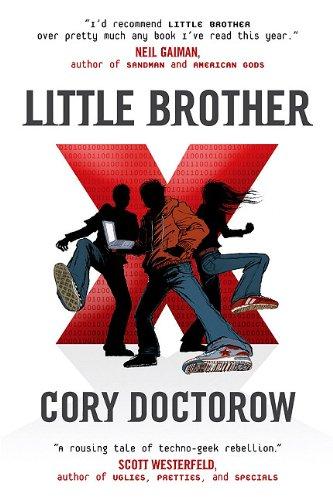
Cover of the Tor Teen edition.