Minority Report
Spielberg's sleekest machine is a chase film with a philosophy degree, and it predicted almost everything except where we'd be looking.
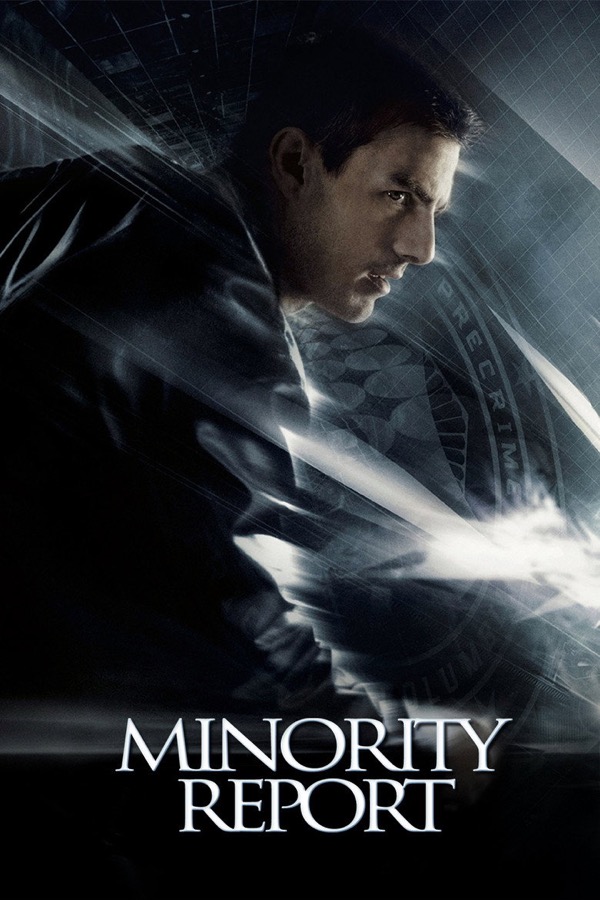
The talking billboards and hand-waving screens are partly here, and Precrime was tried and quietly shut down, but nobody in the film's 2054 stares at a phone.
There is a moment midway through Minority Report when Tom Cruise, newly fitted with a stranger's eyes, drops his own pair on the floor of a run-down tenement and has to scramble after them as they roll away down a corridor. It is grotesque and very funny and completely nerve-racking all at once. And it tells you everything about why this film has lasted. Spielberg spent a fortune imagining 2054, then built his best scene around the oldest gag in cinema: a man running after something he's dropped.
Released in June 2002, Minority Report is usually filed as Spielberg's "serious" sci-fi, the clever cousin of A.I. It's better described as a very expensive B-movie that went to university. The source is a 1956 Philip K. Dick story about three psychics who foresee murders. The screenplay, by Scott Frank and Jon Cohen, keeps Dick's paranoia and pours a classic wrong-man thriller over it. Cruise plays John Anderton, chief of Washington's Precrime unit, who is forecast to kill a man he has never met and spends the next two hours trying to outrun his own future. The poster said it best: Everybody runs.
The film's history is almost better than its plot. It began life in the early 1990s as a possible sequel to Total Recall, with Arnold Schwarzenegger in mind. Picture that for a second: Arnie, in a bathrobe, shouting at a precog. Instead it found its way to Cruise, who brought it to Spielberg, and the two men reportedly took a share of the gross rather than upfront fees to keep the budget near $100 million. Then, in 1999, Spielberg did the thing that made the film famous among people who never watch films. He gathered fifteen experts at a hotel in Santa Monica for a three-day "think tank" about what 2054 might look like. The futurist Peter Schwartz and Stewart Brand convened it. The guest list included the virtual-reality pioneer Jaron Lanier, the novelist Douglas Coupland and the MIT physicist Neil Gershenfeld. Out of those three days came an 80-page "2054 bible", compiled by the production designer Alex McDowell, which governed everything from the cars to the cereal boxes.
You can feel that bible in every frame. Few science-fiction films are this furnished. Self-driving cars glide up the sides of buildings. A commuter's newspaper updates itself while he reads it. Robotic "spyders" skitter through an apartment block, crawling under doors to scan the eyes of everyone inside, and Spielberg shoots the sequence from above, like a cross-section of a doll's house. Upstairs, Cruise lies under a bath full of iced water, trying not to let a single bubble rise. It is a superb piece of staging, the kind of thing Hitchcock would have killed for, and it's typical of the film's best instinct: take a gadget and find the human panic inside it.
Then there's the look. Janusz Kamiński, Spielberg's cinematographer since Schindler's List, shot the film on film and put it through a bleach-bypass process at the lab, which leaves silver in the image and drains the colour out. The result is a future that looks over-washed: cold blue-greys, blown-out whites, skin the colour of skimmed milk. Spielberg pointed to The Maltese Falcon and The Asphalt Jungle as influences, and it shows. This is noir with a maglev system. In 2002 it looked daring. Today it looks prophetic in a way nobody intended, because so much of the decade that followed copied it. It's hard to watch the grey-blue, slightly grainy futures of the next decade's blockbusters without seeing its fingerprints.
It's also why the film has aged better than most of its peers. Its 2054 doesn't look like 2002's idea of shiny. It looks tired, lived in, a bit overexposed. The future came pre-faded.
Cruise is very good here, and it's worth saying because he's so easy to take for granted. Anderton is a grieving father with a drug habit who believes in the system completely until it turns on him. Cruise plays the first half as a man holding himself together by sheer speed, then lets the control fall away. Colin Farrell, as the Justice Department man sent to check on Precrime, is smug and sharp and fun. Max von Sydow brings the gravity of a whole Bergman back catalogue to the role of Precrime's director. Lois Smith gets one wonderful scene in a greenhouse as the scientist who invented the whole thing and now spends her days breeding poisonous plants.
But the film belongs to Samantha Morton as Agatha, the most gifted of the precogs. She spends half the film being dragged around by Cruise, which could have been thankless, and instead she becomes its conscience. The best sequence in the film is hers. In a busy shopping centre, she sees a few seconds ahead and steers Anderton through the crowd, telling him when to stop and when to walk. At the crucial moment, a man with an armful of balloons steps between them and their pursuers. It's a chase scene where the hero wins by standing still, and it's the film's whole argument about fate in two minutes of choreography.
Now the bad news. The last half-hour is a mess, and fans have been arguing about it for two decades because it is a mess.
Without spoiling too much: once Anderton is caught and sent into the prison where the "haloed" are kept in a kind of sleep, the film suddenly resolves everything. The villain is unmasked. The system falls. The family is mended. A popular theory holds that none of it happens, and that we're watching Anderton's dream. The case rests partly on a line from the prison's jailer, played by Tim Blake Nelson, who says the haloed have visions in which their dreams come true. It's an attractive theory. I don't think Spielberg means it. I think he couldn't help himself. He has always had trouble leaving people in the dark, and after more than two hours of mud and blue light, he flicks the lamps on and sends everyone home. Whether it's a dream or a cop-out, the last act feels like someone else's film.
The other problem is the advertising. The product placement, from Lexus to the Gap, was mocked in 2002 and is still distracting now. The film wants to satirise a world in which every surface tries to sell you something, and it does this by having every surface try to sell you something. Some critics call that clever. Mostly it's just loud.
As prophecy, the film's record is wonderful and a bit humbling. It got the gesture interface, designed by the MIT researcher John Underkoffler, so right that it became the default image of "the future of computing" for twenty years, and the pinch-and-swipe gestures of today's headsets are its grandchildren. It got the billboard that knows your name, the newspaper that refreshes itself and the car that drives itself. It got the police computer that claims to see crime coming. That one really was tried in the 2010s, and it went badly.
What it missed is right there in the crowd scenes. Everyone in Spielberg's 2054 is looking up: at walls, at billboards, at holograms in shop windows. The film imagined that the screens would come to us, on every surface of the city. It never imagined that we would carry them, and that a whole planet would spend its days looking down at a slab of glass in its palm. The eye-scanning billboard was clever. The real thing was much simpler. We hand over our attention, and we pay for the privilege.
That's not really a criticism. It's the sort of miss that only a film this precise about everything else could make. Minority Report is a great entertainment with one wobbly act, a gorgeous, grimy object and the most quoted science-fiction design brief in Hollywood history. Roger Ebert called it a masterpiece. That's a stretch. But it's close enough to touch.
What it predicted, and what happened
Minority Report is more prescient about interfaces and surveillance than about policing: gesture-driven computers and driverless taxis are already on sale, and face recognition in public is spreading, while Precrime itself was tried in a weaker form and largely abandoned. Its clearest miss is the phone, because personalised selling and live news reached us through a screen in the hand, not through walls and sheets of electronic paper.
-
MR-1
Police arrest and detain people for crimes that a prediction system says they will commit, before any offence has taken place.
The nearest real versions forecast places or scored individuals for police attention, rather than licensing pre-emptive arrest, and the best-known of them was dropped after its makers failed to show that it worked. An independent test of Geolitica's (formerly PredPol's) predictions in Plainfield, New Jersey, found that fewer than half of one per cent matched a reported crime. Since February 2025 the EU AI Act has prohibited predicting an individual's offending based solely on profiling. Person-level risk prediction is still being researched, for example by the UK Ministry of Justice, so the impulse survives, but detention for a crime not yet committed is not where the legal or technical trend points. 1234
-
MR-2
Advertising screens in public places identify individual passers-by from a biometric scan and address them by name with personalised adverts.
Partial forms exist. Camera-equipped billboards in shopping centres and transport hubs estimate a viewer's age, gender and sometimes mood, then switch the advert, but their operators say the systems detect faces rather than recognise specific people. Identifying named individuals is technically feasible but meets privacy law and courts: São Paulo's metro operator was ordered to stop, and Canada's privacy commissioner opened an investigation in 2025. Personalisation by identity mostly arrived on phones instead, so the film's public version may never become normal; the wide range and low confidence reflect that. 567
-
MR-3
Commercial computers can be operated by mid-air hand gestures, so that users grab, pinch and fling windows of information without touching a screen or controller.
Apple's Vision Pro went on sale in February 2024 with an interface driven by the eyes, finger taps and wrist flicks, and Meta's 2025 display glasses take pinch and swipe gestures through a muscle-sensing wristband. Earlier niche systems, such as Microsoft's Kinect and HoloLens, did similar things, but 2024 is when a mainstream general-purpose computer shipped with gesture as its main input. The arrival is real but small: Vision Pro sold well below expectations, and the film's picture of gesture walls as ordinary office equipment has not happened. 8910
-
MR-4
People are identified automatically by biometric scanners as they move through public spaces, without stopping or showing any document.
The film imagined retinal scanning; the real technology is face recognition from ordinary cameras. London's police now run fixed live facial-recognition cameras in Croydon, which scanned more than 470,000 passers-by in a six-month pilot, and Clearview AI built a searchable database of about 30 billion scraped faces. Iris scanning exists at scale only with consent, through World's Orb. Legal limits are the main brake: European regulators have fined Clearview, the EU AI Act restricts real-time police biometric identification in public spaces, and the date depends on how far democracies other than the UK follow. 11121314
-
MR-5
Members of the public ride in cars that drive themselves through city streets with no human driver on board.
Waymo opened fully driverless rides to the public in the Phoenix area in October 2020, and by February 2026 it reported about 400,000 paid rides a week across six US cities. The path has not been smooth: California suspended Cruise's driverless permits in 2023 and General Motors abandoned robotaxi development the following year. The film's fuller vision, of a city where nearly every car runs on an automated network that police can take over remotely, is still a long way off. 15161718
-
MR-6
Newspapers are thin, flexible sheets of electronic paper that update their headlines and pictures live while you read them.
Flexible electronic paper does exist, and E Ink announced mass production of a plastic-backed panel in 2013, but it refreshes too slowly for moving pictures and never became a news medium. A dedicated e-paper newspaper reader from Plastic Logic was cancelled in 2010 after the iPad arrived. The function the film imagined, news that updates itself as you read, did arrive, but on phones and other glass-screened devices, which are now where most Americans get news, while print has shrunk to a minority habit. 192021
- AGAINST The Los Angeles Police Department Says It Is Dumping A Controversial Predictive Policing Tool. BuzzFeed News, 2020-04-21. The LAPD, an early adopter since 2011, stopped using PredPol, citing budget pressures. Internal audits had struggled to show that it reduced crime.
- AGAINST Predictive Policing Software Terrible At Predicting Crimes. The Markup, 2023-10-02. Of 23,631 Geolitica predictions for Plainfield police in 2018, fewer than half of one per cent matched a reported crime of the predicted type.
- AGAINST Article 5: Prohibited AI practices. European Commission, AI Act Service Desk, 2024-06-13. Article 5(1)(d) of Regulation (EU) 2024/1689 bans AI risk assessments that predict whether a person will commit an offence based solely on profiling.
- CONTEXT UK: Ministry of Justice secretly developing 'murder prediction' system. Statewatch, 2025-04-08. Documents obtained under freedom of information show a UK research project to identify people at risk of committing homicide, using police data on 100,000 to 500,000 people.
- FOR Facial detection used by Westfield malls for targeted advertising. Consumer NZ, 2023-06-30. Shopping-centre screens estimate viewers' age, gender and mood and change adverts accordingly. The supplier says they do not identify individuals.
- FOR Canada's privacy regulator to probe billboards equipped with facial scanning tech. The Record from Recorded Future News, 2025-12-12. Billboards near Toronto's Union Station use facial detection for targeted ads (age and gender only, according to the owner). The regulator is investigating.
- AGAINST Privacy win for 350,000 people in São Paulo: court blocks facial recognition cameras in metro. Access Now, 2021-05-12. A São Paulo court ordered the metro operator ViaQuatro to stop capturing commuters' faces for advertising without consent, and to pay damages.
- FOR Apple Vision Pro available in the U.S. on February 2. Apple Newsroom, 2024-01-08. Apple describes an input system 'controlled entirely by a user's eyes, hands, and voice', with finger taps to select and wrist flicks to scroll.
- FOR Meta Ray-Ban Display: AI Glasses With an EMG Wristband. Meta, 2025-09-17. Consumer glasses, on sale from September 2025 at $799, controlled by thumb swipes and pinches read from muscle signals at the wrist.
- AGAINST Apple reportedly ceases Vision Pro production amid sluggish sales. SiliconANGLE, 2025-01-01. Citing MacRumors, it reports that production was wound down after sales of about 370,000 units in three quarters, against a target of 700,000 to 800,000 in the first year.
- FOR London cops hail fixed facial recognition cams after suspects collared every 35 mins. The Register, 2026-05-13. Two fixed cameras in Croydon led to 173 arrests between October 2025 and March 2026; more than 470,000 people walked past them.
- CONTEXT World(coin) must let Europeans comprehensively delete their data, under privacy order. TechCrunch, 2024-12-19. Iris-based identity exists at commercial scale through World's Orb, but Bavaria's data protection authority ordered it to allow full deletion of iris data.
- AGAINST Clearview AI hit with its largest GDPR fine yet as Dutch regulator considers holding execs personally liable. TechCrunch, 2024-09-03. The Dutch regulator fined Clearview €30.5 million over its database of about 30 billion scraped facial images.
- AGAINST Article 5: Prohibited AI practices. European Commission, AI Act Service Desk, 2024-06-13. Article 5(1)(h) bans real-time remote biometric identification in public spaces for law enforcement except in narrow cases; 5(1)(e) bans untargeted scraping of faces.
- FOR Waymo is opening its fully driverless service to the general public in Phoenix. Waymo, 2020-10-08. Waymo One riders in the Phoenix area could hail rides with nobody in the driver's seat.
- FOR Waymo Co-CEO Outlines Path to 1 Million Weekly Trips in 2026. Bloomberg (via Claims Journal), 2026-02-12. Waymo reported about 400,000 paid rides a week across six US cities, aiming for more than one million by the end of 2026.
- AGAINST DMV Statement on Cruise LLC Suspension. California Department of Motor Vehicles, 2023-10-24. California suspended Cruise's driverless deployment and testing permits, finding its vehicles not safe for public operation.
- AGAINST GM to refocus autonomous driving development on personal vehicles. General Motors, 2024-12-10. GM stopped funding Cruise's robotaxi work, citing the time and money needed to scale it and an increasingly competitive market.
- CONTEXT E Ink Introduces Mobius, the First Large Format Flexible Display Technology to Go into Mass Production. E Ink, 2013-05-13. A 13.3-inch flexible e-paper display on a plastic substrate, weighing about 60 grams, slated for mass production.
- AGAINST Plastic Logic yanks Que e-reader from its queue. Associated Press (via NBC News), 2010-08-11. The e-paper reader built for newspapers and documents was cancelled before launch, as the iPad and cheaper Kindles reshaped the market.
- AGAINST News Platform Fact Sheet. Pew Research Center, 2026-10-19. In 2026, 88% of US adults got news from digital devices often or sometimes, against 22% from printed newspapers or magazines.
Ledger updated 1 Nov 2026. See it on the Nearness Board · Method
Poster © 20th Century Fox / DreamWorks Pictures. Via TMDB.