The Labour Crosses, the Body Stays
Alex Rivera's low-budget Sundance film is clumsy as drama and almost frighteningly sharp as economics, and its central idea, labour that crosses the border without the worker, is starting to come true.
Remote humans already guide robots and robotaxis from far away, water rights trade on an index and the border wall is still going up, though nobody is yet plugging their nervous system into a factory.
In October 2025 the robotics company 1X opened orders for its home robot, Neo, at $20,000. The sales page has a line that's easy to skim past. For any chore Neo doesn't yet know, owners "can schedule a 1X Expert to guide it through unknown tasks". The page doesn't say who the expert is, where they sit or what they earn.
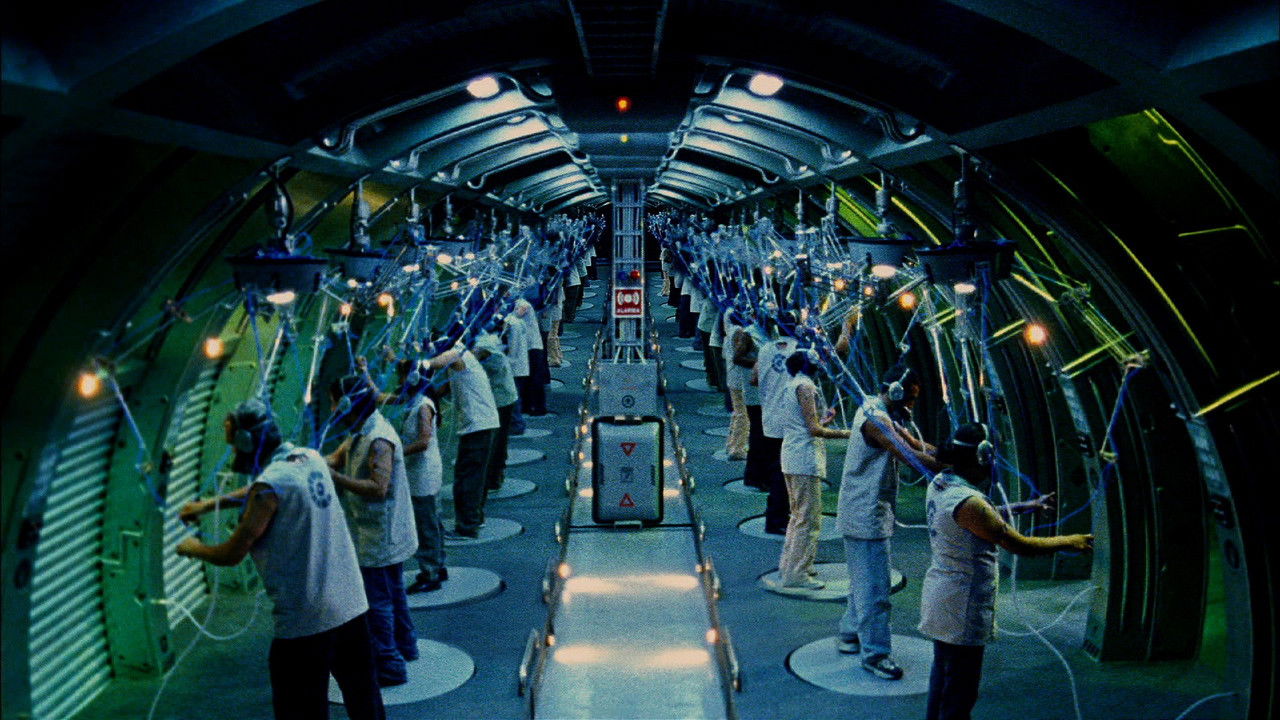
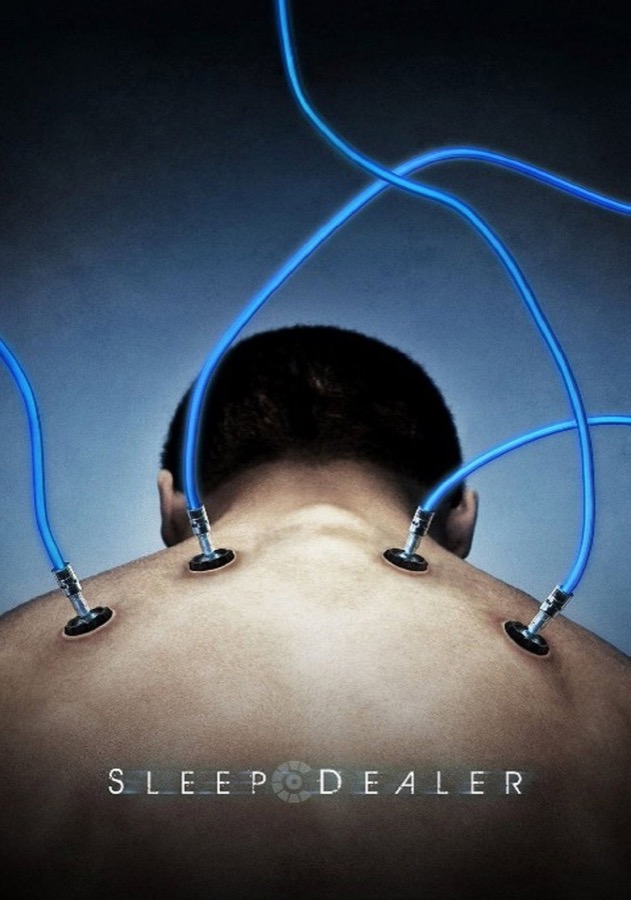
Alex Rivera answered those questions in 2008. In Sleep Dealer, America has sealed its border with Mexico and still wants Mexican labour. So the workers stay in Tijuana, plug cables into nodes implanted in their bodies, and drive robots in factories and on farms in the United States. In the MacArthur Foundation's summary of Rivera's work, America's appetite for low-wage labour is "fulfilled by workers in Mexico who control robots in U.S. factories and farms via technology implanted in their bodies." The film's idea is simpler, and darker: the US gets the work and never has to see the worker.
That idea was ahead of its time. The film around it is less strong.
The art: the ideas outrun the drama
The plot follows Memo Cruz (Luis Fernando Peña), a young man in Santa Ana del Rio, a village in Oaxaca. A private company, Del Rio Water, has dammed the river. Memo's family now walks to the reservoir to buy water by the bag, watched by security cameras fitted with machine guns. Memo is a hobbyist with a home-made radio receiver. When he picks up the frequency used by the company's drones, the drones come for him. His father is killed in a strike that's broadcast live on television. The pilot is a Mexican-American, Rudy Ramirez (Jacob Vargas), who watches the man die through his drone's camera.
Memo goes north to Tijuana. On the bus he meets Luz Martínez (Leonor Varela), who has nodes in her wrists and makes money uploading her memories to an online marketplace called TruNode, where strangers pay to experience them. She gets him connected, and he gets a job in a "sleep dealer", a factory hall where rows of workers hang from cables and move their arms, operating machines in a country they're not allowed to enter. The film's best images are here. Lit green and blue, the hall looks somewhere between a gym and a chapel. And it's a chilling picture of a supply chain with the people taken out.
The rest is uneven. Sleep Dealer won the Waldo Salt Screenwriting Award and the Alfred P. Sloan Prize at Sundance in 2008, and you can see why: on the page, every element connects. The water, the drones, the factory and the memory market all turn out to be the same system. On screen, the connections are made in speeches. Peña is a stiff lead, and the romance with Luz exists mainly to deliver a twist. It turns out Luz has been paid to upload her memories of Memo, and the buyer is Ramirez. Rotten Tomatoes' critics' consensus, which says the film's "depth and energy are almost enough to overcome a shaky screenplay and pedestrian acting", is fair. The low budget shows in the virtual scenes, which already looked dated in 2008. The climax, where Ramirez hacks a company drone and blows a hole in the dam, is an action-film ending tacked onto a film about structures, and structures don't explode.
What survives is Ramirez. Vargas plays the drone pilot as a man who was following orders and has killed a farmer on camera for a TV audience. Buying Luz's memories is his way of finding out who he killed. That's a better story than the one the film puts at its centre. Rivera, who became a MacArthur Fellow in 2021 and later made The Infiltrators with Cristina Ibarra, is a sharper thinker than he was, at 34, a director of actors. A 6.8 respects the thinking and admits the rest.
The prophecy: everything except the cables
Remote labour. This is the film's central bet, and it's starting to pay off, though not in the shape Rivera drew. Nobody has jacked into a factory. What exists is quieter. Waymo's robotaxis can call on human "fleet response" agents, who look through the car's cameras and suggest a path when the car gets stuck. Waymo's own blog compares it to phone-a-friend. 1X sells a home robot with a human "expert" you can book to guide it. These are early systems, and Waymo stresses that the car stays in control. But the arrangement is the one in Sleep Dealer: the robot does the work in a rich country, a person somewhere else helps it, and the person can be anywhere the wages are lower. In the late 2010s, the debate was about whether robots would replace migrant workers. The more likely answer in the 2020s is that robots are how the work gets done without letting the workers in.
Water. Rivera made water a private commodity, defended by force. Half of that has arrived. Since 2018 the Nasdaq Veles California Water Index has tracked the spot price of water rights in California, and in late 2026 it's still publishing a price. The machine guns are, thankfully, still fiction. The idea that water is something you can price and trade isn't.
The wall. In the film the border is sealed. In 2026 the US government is fighting in court to keep building wall through the Big Bend region of West Texas, after a federal judge ordered the work to stop. It's not finished, and the fight over it is very much ongoing.
The drones. The film shows remote drone strikes broadcast live to viewers at home. Of all its predictions, that's the one that has arrived most completely. In the wars of the 2020s, drone strike footage became its own genre of online video.
The nodes. The implanted ports, and the memory marketplace that depends on them, are still far away. The most advanced brain-computer interfaces of the 2020s, like the speech implant reported in Nature in 2023 that turned a participant's attempted speech into text after illness had taken away their ability to speak clearly, are medical devices for people with serious disabilities. No one is selling memories, and no one is plugging their spine into a factory. For once, the film's body horror was more pessimistic than reality.
The reading
Sleep Dealer is a minor film with a major idea. It's stiffly acted and bluntly plotted. It also has the clearest grasp of any film of its decade of what globalisation would do with technology once it had it. Rivera saw that the cheapest border is the one you never have to open, and that the internet could carry labour as easily as information. Almost two decades on, the cables are still fiction. The arrangement isn't. The labour crosses. The body stays.
What it predicted, and what happened
Sharpest on economics: remote humans now help robots and robotaxis from afar, water rights trade on a price index and the border wall keeps going up. The body horror missed. Neural ports for work and a market in recorded memories remain far off.
-
SLD-1
Workers in one place remotely operate or guide robots that do physical work somewhere else.
Human-in-the-loop remote help is now built into commercial robots. Waymo's fleet response agents advise its robotaxis remotely, and 1X sells a home robot with bookable human 'experts' to guide unfamiliar chores. The film's full version, where cross-border workers do the physical labour through robots as routine employment, is not yet documented at scale. 12
-
SLD-2
Water becomes a privately controlled commodity whose price is set by markets.
Water rights in California have a published spot-price index, which has run since October 2018 and still updates in 2026. The film's armed, privatised dam remains fiction, and water's status as a public good is still the global policy norm, even as the UN warns progress on water goals is off track. 34
-
SLD-3
A fortified wall effectively closes the US–Mexico border to unauthorised crossing.
Barrier construction is still expanding in 2026, including contested projects in the Big Bend region of West Texas, and federal courts and environmental suits keep slowing it. A border sealed in the film's sense depends on politics more than engineering, so the date range is wide. 56
-
SLD-4
Workers plug their nervous systems into a network through implanted nodes, to work and to sell recorded memories.
Implanted brain-computer interfaces now decode attempted speech and movement, but only as medical devices for people with severe disabilities, implanted surgically into the brain. Recording and replaying experiential memory, or controlling industrial robots through peripheral ports, has no credible near-term path. 78
- FOR Fleet response: Lending a helpful hand to Waymo's autonomously driven vehicles. Waymo, 2024-05-21. Remote human agents view live camera feeds and propose paths for driverless cars, though Waymo says the car stays in control.
- FOR NEO Home Robot | Order Today. 1X, 2025-10-28. $20,000 home robot; owners can schedule a '1X Expert' to guide it through tasks it doesn't yet know.
- FOR Nasdaq Veles California Water Index (NQH2O). Nasdaq Global Indexes, 2026-10-28. Tracks the spot price of California water rights; began 31 October 2018 and is still published.
- CONTEXT UN 2023 Water Conference. United Nations Department of Economic and Social Affairs, 2023-03-22. First UN water conference in a generation; frames water as a shared good and says progress on water targets is alarmingly off track.
- FOR Trump admin asks judge to let Big Bend border construction continue. Houston Public Media, 2026-10-09. Wall construction pushing into West Texas's least-trafficked sector; also shows a federal judge pausing the work.
- CONTEXT Southwest Land Border Encounters. U.S. Customs and Border Protection, 2026-09-16. Official monthly encounter statistics for the southwest border, the measure of whether crossing has actually stopped.
- CONTEXT A high-performance speech neuroprosthesis. Nature, 2023-08-23. Intracortical implant turns a participant's attempted speech into text: the state of the art is restoring function, not networking workers.
- CONTEXT Developing a hippocampal neural prosthetic to facilitate human memory encoding and recall. Journal of Neural Engineering, 2018-06-01. Stimulation can modestly improve memory encoding; nothing approaches recording memories for others to replay.
Ledger updated 1 Nov 2026. See it on the Nearness Board · Method