Hamlet at the Airport
HBO Max's pandemic drama arrived in the middle of a real one and refused to be grim about it. It is the gentlest end of the world on television, and the most useful.
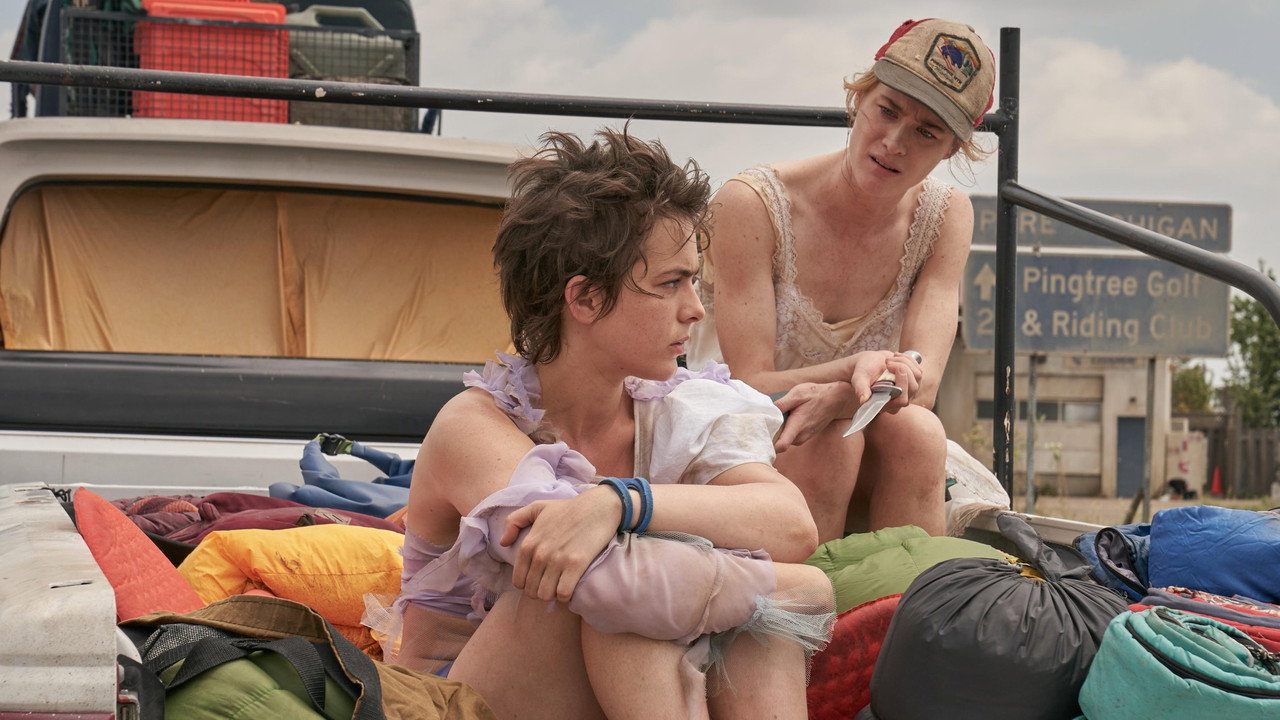

Grounded planes, sealed flats and quarantined passengers all arrived in 2020; the flu that kills almost everyone did not, and nothing we know of is on course to.
Nobody chose the timing. The first three episodes of Station Eleven went up on HBO Max on 16 December 2021, twenty days after the World Health Organization named Omicron a variant of concern. So a drama about a flu that empties the world reached its audience as a new wave was filling the hospitals again. Skipping it would have been understandable. It would also have been a mistake. This is the rare apocalypse that wants to cheer you up.
The production had lived through the same thing. Hiro Murai's two episodes, the first and the third, were shot in Chicago in early 2020. The crew went on a planned break, and the break turned into the one everyone else was taking. When filming resumed the following year it had moved to Mississauga, on the edge of Toronto, the city where Emily St. John Mandel set the opening of her 2014 novel before the showrunner, Patrick Somerville, moved it to Chicago.
The art: a show that keeps its coat on
The first episode is close to perfect. Arthur Leander (Gael García Bernal) dies on stage in the middle of King Lear. Jeevan Chaudhary (Himesh Patel), a man in the audience with nothing much going for him, climbs up to help, fails, and ends up taking charge of a child actor called Kirsten (Matilda Lawler) on a snowy night as a flu starts to move through the city. Within days the two of them are holed up in the flat of Jeevan's brother Frank (Nabhaan Rizwan), watching the city stop. Murai shoots the end of the world as a series of small domestic decisions: a supermarket trolley piled too high, a door locked, a city watched through a window. The big event happens off to one side. It feels like a memory.
Then the show jumps twenty years, and that's where it shows its hand. The grown Kirsten (Mackenzie Davis) is the star of the Travelling Symphony, a troupe of actors and musicians who walk a fixed loop they call the Wheel, putting on Shakespeare for whoever is left. They're led by Sarah, played by Lori Petty with a weary, generous authority that makes you wish the show had given her an episode of her own. They wear salvaged costumes and treat a matinee in a ruined town as seriously as opening night at the Globe. The phrase that names the sixth episode, "Survival Is Insufficient", is the whole thesis. Staying alive isn't the point. You have to have something to stay alive for.
Davis is very good at a hard job. Kirsten is a survivor who is quick with a knife and a performer who takes her lines more seriously than her safety, and Davis plays both without signalling either. Lawler, as her younger self, is even better: a child who meets catastrophe as if it were a scene she has to get right. Patel gives the series its heart. His Jeevan is useless, then frightened, then braver than he meant to be. He was later nominated for an Emmy, one of the show's seven nominations, and it's hard to think of a better performance of a man who never asked to be the adult in the room.
The structure is the boldest thing about it. It shuttles across decades, follows Arthur's ex-wife Miranda (Danielle Deadwyler) and his old friend Clark (David Wilmot) through their own private ends of the world, and trusts you to put it together. The seventh episode, in which a poisoned, delirious Kirsten relives her winter in Frank's flat, is the high point. Dan Romer's score helps throughout, never louder than it needs to be.
It isn't flawless. The middle stretch, built round a cult led by a figure called the Prophet, loses its grip, and the decision to make him less of a villain than the novel's version leads to a finale that forgives a little too quickly. When everyone finally meets at Severn City Airport for a performance of Hamlet, the closing episode hands out absolution with the generosity of a curtain call. Somerville's instinct for tenderness is the show's great strength. At the end it is also its weakness: by the tenth hour every wound has a dressing. That is the gap between this and a 9.
The prophecy: the end of the world, rehearsed
Here's the awkward truth about Station Eleven as forecasting. Its most accurate scenes were filmed before most of them happened, and released after all of them had.
The grounding. In the show, flight stops almost overnight and the planes sit on the tarmac. In April 2020, global air passenger demand fell 94.3 per cent on the year before, by IATA's count, the steepest drop in its records. Over the whole of 2020, passenger numbers fell by about 60 per cent. That arrived exactly as filmed. It also came back. By 2024 air traffic was higher than it had been in 2019, which is the bit no apocalypse ever imagines: that people would simply start flying again.
The flat. Jeevan, Kirsten and Frank seal themselves in with a stockpile and watch the city through the glass. While Murai was shooting, Wuhan was already sealed; it stayed locked down for 76 days. Within weeks, much of the world was doing the same. In the mid-2020s, it was possible to watch the first episode and recognise the shopping.
The plane. In the series a plane sits sealed on the tarmac at Severn City with its passengers inside, and Miranda's final act is to make sure they stay there. It is the show's cruellest image, and the real version was a ship. In February 2020 the Diamond Princess was held off Yokohama with 3,711 people aboard, and 712 of them tested positive. A team at Umeå University estimated that keeping everyone on board, rather than evacuating, led to far more infections. The show had the instinct right: the first response to a sick vessel is to close the door.
The flu. This is where the fiction parts company with us. Mandel's flu kills nearly everyone within weeks. The worst pandemic of our lifetimes was associated with about 14.9 million excess deaths in its first two years, by the WHO's estimate: a horror, and roughly one person in five hundred. Lethal flu strains exist, and H5N1 has killed many of the people it has infected, but none has yet shown sustained spread between people. Civilisation turned out to be sturdier than the show needs it to be, and stupider: what kept the lights on was people turning up to work in power stations and shops.
Which leaves the show's real prediction, and its sharpest. The Prophet's followers believe the pandemic never happened. In the story that's a plot point. By the time the series aired, a version of it was already a political position. Station Eleven guessed that after a catastrophe, some people would refuse to believe there had been one.
The reading
As prophecy, Station Eleven is less a forecast than a counter-forecast. Most collapse stories bet on what breaks. This one bets on what lasts: a comic book, a play, a habit of gathering in a room to watch someone pretend to be someone else. In the period when everyone was told to stay home, culture fled to screens rather than to wagons. But the show was right that people would want stories more, not less, when everything else had stopped.
It's warm, beautifully acted and occasionally too pleased with its own kindness. It's also the only end of the world on television you'd want to watch again. The world ends. The tour goes on.
What it predicted, and what happened
Filmed partly before and released after COVID-19, the series' picture of the first weeks of a pandemic (grounded planes, sealed flats, passengers held aboard) arrived almost scene for scene in 2020. Its central premise, a flu that kills nearly everyone and ends industrial civilisation, remains far off: the real pandemic killed a fraction of a per cent and the world kept running.
-
STATION11-1
A fast-spreading respiratory pandemic grounds most of the world's passenger flights within weeks.
In April 2020 global passenger demand fell 94.3% year on year, the steepest drop in IATA's records, and passenger numbers for 2020 as a whole fell by about 60%. Unlike in the series, the grounding was temporary: by 2024 traffic had passed its 2019 level. 123
-
STATION11-2
City dwellers seal themselves in their homes for weeks or months, living off stockpiles while an outbreak runs through the city outside.
Wuhan was locked down for 76 days from January 2020, and within weeks stay-at-home orders spread across most of the world, as documented country by country by the Oxford COVID-19 Government Response Tracker. The real version was enforced by governments and supplied by delivery drivers rather than improvised by frightened households. 45
-
STATION11-3
Passengers arriving on a vessel carrying the disease are kept aboard it in quarantine rather than let off.
In February 2020 the Diamond Princess was quarantined at Yokohama with 3,711 people aboard; 712 tested positive. Modellers at Umeå University estimated that the onboard quarantine prevented thousands of cases compared with doing nothing, but caused far more infections than evacuating the ship would have, which is close to the moral the series draws from its sealed plane. 67
-
STATION11-4
A flu strain kills nearly all of humanity within weeks, and power, communications and government collapse with it.
The worst pandemic in a century was associated with about 14.9 million excess deaths in 2020 and 2021, roughly one person in five hundred, and infrastructure kept running throughout. Highly lethal avian flu strains exist, but none has shown sustained human-to-human spread, and the near-total lethality the series needs has no precedent. Preparedness is rising slowly: the WHO Pandemic Agreement was adopted in 2025. The date range is a placeholder for a very unlikely tail risk. 8910
- FOR After April Passenger Demand Trough, First Signals of Uptick. IATA, 2020-06-03. April 2020 revenue passenger kilometres down 94.3% on April 2019; international down 98.4%.
- FOR 2020 passenger totals drop 60 per cent as COVID-19 assault on international mobility continues. ICAO (Uniting Aviation), 2021-01-22. Global air passengers fell from 4.5 billion in 2019 to 1.8 billion in 2020.
- AGAINST Global Air Passenger Demand Reaches Record High in 2024. IATA, 2025-01-30. Traffic in 2024 finished about 3.8% above 2019: the grounding was a pause, not an ending.
- FOR After 76 days in coronavirus lockdown, residents in Wuhan start to resume normal life. SBS News, 2020-04-08. Wuhan's lockdown lifted after 76 days, or about 11 weeks.
- FOR A global panel database of pandemic policies (Oxford COVID-19 Government Response Tracker). Nature Human Behaviour, 2021-03-08. Tracks closure and containment policies, including stay-at-home requirements, across more than 180 countries from January 2020.
- FOR Public Health Responses to COVID-19 Outbreaks on Cruise Ships — Worldwide, February–March 2020. CDC, Morbidity and Mortality Weekly Report, 2020-03-27. Diamond Princess: 712 of 3,711 aboard tested positive; uninfected passengers completed a 14-day ship-based quarantine.
- CONTEXT Quarantine on cruise ship resulted in more Corona patients. Umeå University, 2020-02-28. Modelling suggests early evacuation would have meant about 70 infections rather than the 619 seen during quarantine.
- AGAINST 14.9 million excess deaths associated with the COVID-19 pandemic in 2020 and 2021. World Health Organization, 2022-05-05. A catastrophe, but orders of magnitude short of the series' near-total mortality.
- CONTEXT Influenza (avian and other zoonotic). World Health Organization, 2026-01-21. A(H5) human infections have a higher reported fatality rate than seasonal flu, but no zoonotic strain has shown sustained human-to-human transmission.
- AGAINST World Health Assembly adopts historic Pandemic Agreement to make the world more equitable and safer from future pandemics. World Health Organization, 2025-05-20. Member states adopted a treaty on pandemic preparedness and response by consensus.
Ledger updated 1 Nov 2026. See it on the Nearness Board · Method