Real Time Costs Extra
Kathryn Bigelow's millennium-eve thriller invented a machine that records memories, then accidentally predicted the far more important device in every bystander's pocket.
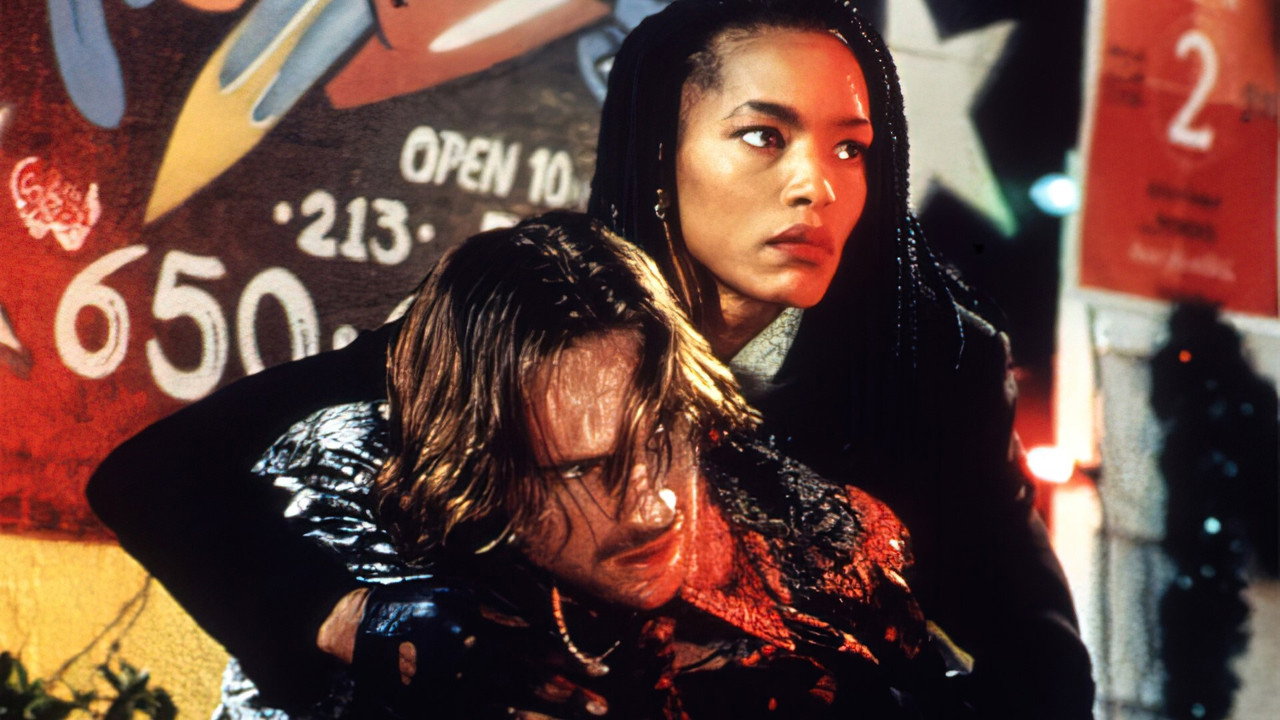
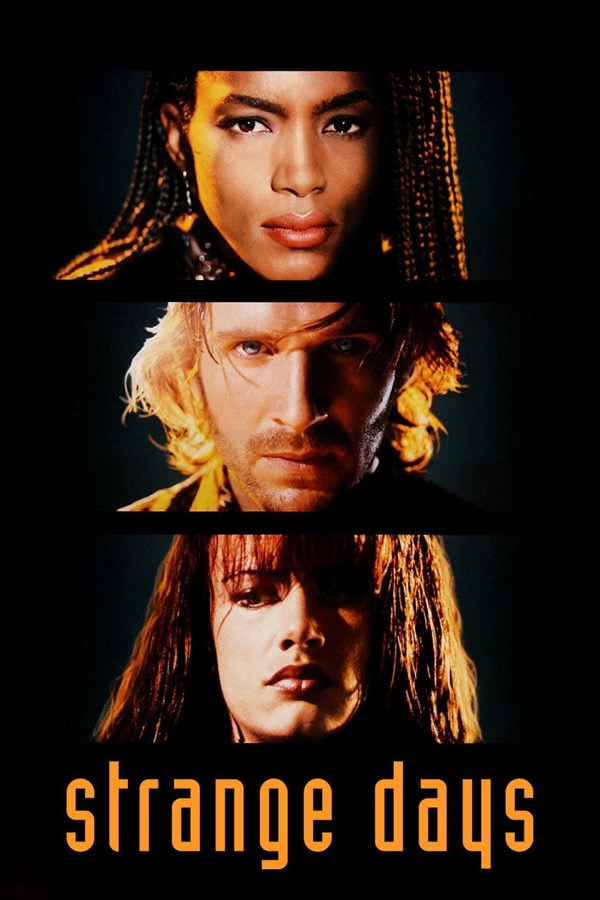
The memory-recording SQUID is still decades off, but the head-worn playback, the police body camera and the bystander video that convicted an officer of murder all arrived on time.
Strange Days opens with a robbery seen through the robber's eyes. You ride along behind his eyes as the job goes wrong, the police arrive and the gang runs for the roof. Then he tries a jump between two buildings, falls short and drops. The tape cuts out. The man watching it, Lenny Nero, rips the rig off his head and complains about the ending.
That jump was a real stunt, performed without a safety harness, and the production spent a year building a lightweight camera to shoot this kind of first-person sequence. Thirty years later it still lands like a punch. Nothing else in the film quite matches it, and the film knows it. Strange Days spends the next two hours trying to live up to its own first five minutes.
The art: a magnificent machine with a bad driver
The device is the SQUID, a headset that records everything its wearer sees, hears and feels, and lets someone else play it back. On the street it's illegal and it's a drug. Lenny (Ralph Fiennes), an ex-cop, deals in "playback": other people's sex, thrills and youth, sold on discs to men in bars. The film is set over the last two days of 1999 in a Los Angeles that looks like it's preparing for a siege, with riot police on the corners and a party that refuses to stop.
The plot is a conspiracy thriller. Iris, a sex worker Lenny knows, is murdered, and the killer records it on a SQUID and sends the tape to Lenny so he feels it from the killer's side. Iris was carrying another recording, of two LAPD officers executing the rapper and activist Jeriko One (Glenn Plummer) at a traffic stop. Lenny's ex, Faith (Juliette Lewis), is tangled up with a music mogul, Philo Gant (Michael Wincott). His friend Max (Tom Sizemore) is not what he seems. And his other friend, the bodyguard and driver Lornette "Mace" Mason (Angela Bassett), keeps rescuing him from himself.
Bassett is the film. Mace is a single mother who works security, punches like a professional and has the only clear moral eye in Los Angeles. She looks at Lenny's trade with the contempt it deserves and tells him, more or less, that life is lived in real time, not on playback. Bassett won the Saturn Award for best actress, and Bigelow became the first woman to win the Saturns' best director award. Fiennes, meanwhile, is miscast in a way that's interesting to watch. He plays Lenny as a wet, dishevelled romantic with a salesman's patter. He's convincing as a man who can't stop rewinding. He's much less convincing as a man anyone would follow into a fight.
James Cameron wrote the story and co-wrote the screenplay with Jay Cocks. You can feel Cameron's engineering in the plot: twists bolted on and wired up, every gun introduced with a little click. Bigelow's direction is wilder than his script. The parties are hot and dense, the camera hunts people through crowds, and the POV sequences remain some of the most upsetting footage in mainstream American film. Roger Ebert called it "a technical tour de force". It was also a flop, taking about $17 million on a $42 million budget.
The ending is the problem. At midnight, Mace takes on the two killer cops in the middle of the crowd. Other officers beat her, the crowd surges in to defend her, and a senior police commander arrives just in time to order her release and arrest the guilty men. Then a kiss and the confetti. Bigelow has said she was thinking about the 1992 riots after the Rodney King verdict, and you can see it in the film's rage. But the resolution is pure wish fulfilment: a good man at the top walks in, the system corrects itself, the tape is believed. That is the gap between 7 and 8.
The prophecy: the wrong camera, the right footage
The SQUID. The headline invention is still the furthest away. Since 2023, research groups have used AI models to rebuild rough images of what people are looking at, and the gist of stories they hear, from fMRI scans. Those systems need a scanner the size of a car, hours of training on a willing volunteer, and they only read. Nobody is anywhere near writing a whole recorded experience into another person's nervous system. The SQUID's playback market is fantasy.
The playback deck. The commercial half arrived in a weaker form. Consumer VR headsets went on sale in 2016, and Apple's Vision Pro was sold partly on letting you "capture and relive memories" in 3D video. People do pay to look out of someone else's eyes. It just isn't the drug the film thought it would be, and in 2026 Meta, the biggest spender in the business, was cutting VR jobs.
The officer's view. By 2016 nearly half of US general-purpose police agencies had body-worn cameras, which record every encounter from the officer's point of view. That is a SQUID with the feelings taken out. The evidence that cameras change police behaviour is weaker than reformers hoped: a large randomised trial in Washington DC found no detectable average effect on use of force or complaints.
The tape that convicts. This is the film's real prophecy, and it was hiding in plain sight. The plot turns on a recording of police officers killing a Black man and a fight over whether anyone will see it. In May 2020, Darnella Frazier, then a teenager, filmed George Floyd's death on her phone. Her video contradicted the first police account, and in April 2021 Derek Chauvin was convicted of murder. Strange Days imagined that the footage would come from a brain implant, be smuggled on a disc, and be delivered to a commissioner who would do the right thing. It came from a phone instead, went everywhere at once, and the justice it delivered was rare enough to be news.
The reading
Strange Days is a flawed, ferocious film that looked dated in 2000 and looks prophetic now. The millennium it imagined never came. Y2K passed off quietly and the riot never came. But the core idea, a city addicted to recorded experience and a fight over who gets to see the recording, describes life after the smartphone better than most films made after it.
Lenny wants to live in playback because playback is safe. Mace knows the expensive format is the present. The film's warning about memory addiction now reads like a note about the camera roll. Real time costs extra. Most of us stopped paying.
What it predicted, and what happened
The SQUID, the film's headline device, is still far off: we can roughly decode what a cooperating brain sees, and we cannot write it into anyone else's. Almost everything around it arrived, including head-worn playback, point-of-view police cameras, and a recorded killing that brought an officer a murder conviction.
-
STRANGEDAYS-1
A device records a person's full sensory experience straight from the brain and plays it back into someone else's.
Researchers can now reconstruct blurry versions of images people are looking at, and the gist of stories they hear, from fMRI scans with AI models. These systems need a large scanner, hours of training on a cooperating volunteer, and they only read. Nobody has a credible route to writing a full recorded experience into another brain. The read half has started. The write half is science fiction. 123
-
STRANGEDAYS-2
Police officers routinely wear cameras that record their encounters from their own point of view.
By 2016 nearly half of US general-purpose law enforcement agencies had acquired body-worn cameras. The evidence that cameras change police behaviour is weaker than the hopes placed in them. A large randomised trial in Washington DC found no detectable average effect on use of force or complaints. 45
-
STRANGEDAYS-3
People pay to watch recorded first-person experiences through a head-worn device.
Consumer VR headsets went on sale in 2016, and Apple launched its own headset with immersive filmed content in 2024. The market is real but small, and the heaviest spender, Meta, began cutting VR staff and studios in 2026. The playback deck exists. It plays back sight and sound, not the full nervous system. 67
-
STRANGEDAYS-4
A recording of police killing a civilian overturns the official account and leads to a murder conviction.
Darnella Frazier's phone video of George Floyd's death contradicted the initial police account. In April 2021 Derek Chauvin was convicted of murder and manslaughter. The film's version has a recording, a cover-up and a conviction, and that sequence happened. What the film got wrong is how rare the outcome is and who would be holding the camera. 89
- FOR Stable Diffusion with Brain Activity. Osaka University / NICT (CVPR 2023), 2023. Takagi and Nishimoto reconstruct high-resolution images from fMRI recordings using a latent diffusion model.
- FOR Semantic reconstruction of continuous language from non-invasive brain recordings. Nature Neuroscience, 2023-05-01. Decodes the gist of continuous language from fMRI.
- AGAINST Brain Activity Decoder Can Reveal Stories in People's Minds. UT News, University of Texas at Austin, 2023-05-01. The decoder needs an fMRI scanner, hours of training per person and a willing subject. Untrained or resisting subjects produce unusable output.
- FOR Body-Worn Cameras in Law Enforcement Agencies, 2016. Bureau of Justice Statistics, 2018-11-16. 47% of general-purpose law enforcement agencies had acquired body-worn cameras by 2016.
- AGAINST Body Worn Cameras. The Lab @ DC, 2017. A randomised trial with DC's Metropolitan Police found no detectable average effect of cameras on documented uses of force or civilian complaints.
- FOR Introducing Apple Vision Pro: Apple's first spatial computer. Apple, 2023-06-05. Apple unveils a head-worn computer built partly around immersive video and recorded spatial memories.
- AGAINST Meta lays off VR employees, underscoring Zuckerberg's pivot to AI. CNBC, 2026-01-14. The biggest investor in headsets cuts VR staff and studios.
- FOR Darnella Frazier: A teen with 'a cell phone and sheer guts' is credited for Derek Chauvin's murder conviction. CNN, 2021-04-21. Credits a bystander's phone video with Chauvin's conviction.
- FOR Darnella Frazier, teen who filmed Floyd's arrest, celebrates Chauvin's guilty verdict. The Seattle Times, 2021-04-21. Reports the verdict and the role of Frazier's footage.
Ledger updated 1 Nov 2026. See it on the Nearness Board · Method