Any Other Business
Kim Stanley Robinson wrote the climate novel that policymakers actually read, which tells you both why it matters and why it so often feels like a meeting.
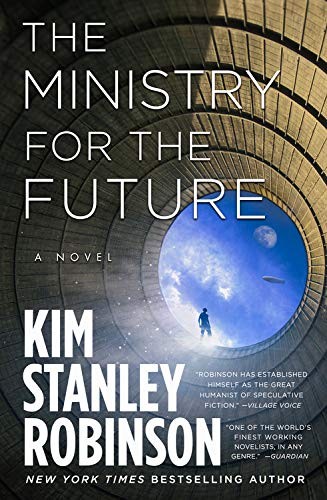
The lethal humid heat, the green central banking and the go-it-alone geoengineering all have real first drafts now, but the carbon coin and the cooperative politics that make the novel work are still on paper.
Most novels hope to be read by a critic. The Ministry for the Future was read by a climate negotiator. Nigel Topping, the UK's High Level Climate Action Champion, read it and invited Kim Stanley Robinson to the COP26 summit in Glasgow, where he was given a red pass that opened any room in the building. Robinson spoke at 38 events in 12 days. Barack Obama had already put the book on his list of favourites for 2020. By 2024, Hertford College in Oxford had launched a network of academics and policymakers named after it.
Hardly any science fiction gets that kind of afterlife. It's worth asking why this book did, because the answer is also the best description of what it's like to read. The Ministry for the Future is a policy brief with a plot. Judged as a brief, it's dazzling. As a novel, it's often a chore.
The art: one great chapter and a long seminar
Start with the chapter everyone talks about, because it deserves the reputation. The book opens in a small town in northern India in 2025, in a pre-monsoon heatwave that keeps getting worse. Frank May, a young American aid worker, watches the town fail, slowly and then all at once. The survivors go down to the lake for relief and find the water as warm as a bath. Frank comes out alive. Hardly anyone else in the town does. Across the country, the heat kills around 20 million people. Robinson writes it flatly, with no swelling music, and that is exactly why it's unbearable. If you read only the first chapter of any climate novel, make it this one.
Then the book changes gear and never really changes back. Over the next 105 chapters (there are 106 in all, across 576 pages), Robinson sets up the Ministry of the title: a small Zurich-based body created under the Paris Agreement to speak for generations not yet born. It's run by Mary Murphy, a tough, tired, decent administrator. Frank, broken by what he saw, drifts towards violence and eventually turns up in Zurich, where he holds Mary at gunpoint in her own flat and tells her the Ministry is useless without a black wing willing to do what diplomacy won't. That scene crackles. Their odd, wary friendship afterwards is the warmest thing in the book.
Around those two, Robinson has built a kind of collage. There are chapters narrated by a photon, by a carbon atom, by the market and by History. There are meeting notes, a Socratic dialogue and short explanatory essays on economics and glaciology. Robinson's editor, Tim Holman, reportedly suggested the variety, and you can see why. It's a way to cover a whole planet's response to a crisis that no single viewpoint could hold. Some of these pieces are terrific. The carbon atom is funny. The short first-person eyewitness fragments work like those short vox-pop clips in documentaries that stay with you longer than the narration.
But a large share of the book is a seminar. Characters explain things to other characters who already know them, so that you'll know them too. A long scene in which Mary lobbies the world's central bankers is, essentially, a lecture on quantitative easing in costume. Kirkus and others complained about the information dumping, and they weren't wrong. Robinson is a generous, clever, humane writer, and here he trusts his ideas far more than his story. The people are there mainly to carry the arguments in from the next room.
The violence gets the same flat tone, which works far less well. Off the page, eco-saboteurs bring down passenger jets by the dozen and torpedo container ships. A group calling itself the Children of Kali emerges from the heatwave's aftermath. At Davos, activists take the delegates hostage and put them through re-education, played as satire. These are huge, morally serious events, and the book reports them like a ministry's quarterly update. Perhaps that's the point. It still means you never feel what it costs.
The prophecy: the parts that came true, and the part that hasn't
This book was written to be checked against reality, and it holds up well to checking. Our ledger below tracks four of its bets.
The heat. In 2020 a wet-bulb temperature of 35°C, the point where sweat stops cooling a body, was something you read about in modelling papers. That same year, a study of weather-station records found it had already been touched, briefly, in a handful of coastal places. Lab work since then suggests real bodies give up earlier, nearer 31°C. India's terrible 2024 heat season came nowhere near the novel's death toll, and its official count was almost certainly too low. Robinson's scenario is still ahead of us. But it's ahead of us in the sense of being coming soon, not science fiction.
The money. The carbon coin, a currency issued for every tonne of carbon kept out of the sky, is the book's favourite idea. It comes from a real proposal, Delton Chen's Global Carbon Reward. Six years on, that proposal is still trying to raise money for a demonstration. The first step does exist, though. In the early 2020s, central banks began to treat climate as their business: the European Central Bank started tilting its corporate bond purchases towards lower-carbon issuers in 2022. Then the Federal Reserve left the central bankers' climate network in January 2025. Robinson saw that the money people would be the last ones to come round, and the most important. He didn't predict that some would come round and then leave.
The sky and the ice. After the heatwave, India's air force starts spraying aerosols into the stratosphere without asking anyone. In reality, the first unilateral move was smaller and more ridiculous: in 2022 a start-up released a few grams of sulphur dioxide from weather balloons in Mexico, and Mexico moved to ban the practice. The serious money is now private. In 2025 a company called Stardust raised $60 million and pitched governments as its future customers. Robinson thought a desperate state would act first. A venture fund may get there before one. His Antarctic scheme, drilling to the bed of glaciers and pumping out the meltwater to slow them down, has become a real field of research, with a test planned on a small Alaskan glacier. A 2025 expert assessment judged it unlikely to work for decades.
The politics. This is the book's biggest prediction, and its least supported one. Robinson's second half needs governments, banks and publics to cooperate, slowly and grudgingly, but genuinely. Airships fill the skies. Shipping goes back to sail. The bankers come round. It's a moving vision, and he's honest about how much violence and luck it takes to get there. But it's the most speculative thing in a book about lethal heat and stratospheric chemistry. The heat has turned up on time. The cooperation hasn't.
The reading
People love this book for a real reason. It refuses to despair, and it's specific about how things might get better. That combination is rare. It explains why a negotiator could hand it to colleagues without embarrassment. As a novel, though, it's a brilliant first chapter, two characters worth caring about and several hundred pages of minutes from a meeting that matters a great deal. Read it for the heat and for the ideas. Skim the bankers. Then check the ledger, because Robinson wrote the one climate novel that asked to be held to account, and on the evidence so far it's doing better than its readers are.
What it predicted, and what happened
Robinson got the shape of the arguments right: humid heat at the edge of survival, central bankers dragged into climate policy, and geoengineering run by whoever moves first. His heaviest bets, the carbon coin and drilling under Antarctic glaciers, are still on paper, and the cooperative politics that makes the novel's second half work is the least supported prediction of all.
-
MFTF-1
A single heatwave in India pushes humid heat past the limit of human survival and kills millions of people within days.
The physics is no longer hypothetical: weather stations have already logged brief readings at the 35°C wet-bulb mark, and lab work suggests the real limit for healthy adults is nearer 31°C. What has not happened is the novel's scale of death. India's officially counted heat deaths in 2024 ran to the low hundreds, though they are widely agreed to be undercounts. A mass-casualty event in the millions needs sustained conditions plus failed power and water systems; plausible under high warming, but nothing on the record comes close. 123
-
MFTF-2
Central banks use monetary policy to pay for decarbonisation, up to a carbon-backed currency that rewards every tonne of CO2 kept out of the air.
The first rung exists: the European Central Bank began tilting its corporate bond purchases towards lower-carbon issuers in October 2022. The carbon coin itself, based on Delton Chen's Global Carbon Reward proposal, has not got past a fundraising-dependent demonstration plan. And the direction of travel reversed in the world's largest central bank, which left the main central-bank climate network in January 2025, citing its mandate. 456
-
MFTF-3
Engineers drill to the beds of Antarctic and Greenland glaciers and pump out the meltwater beneath them to slow the ice's slide into the sea.
Glacial intervention has moved from the margins to funded research programmes, and a proof-of-concept test of increasing basal friction is being planned for a small Alaskan glacier. Nothing has been tried on an ice stream, and the field's own funders say the tools are at the very beginning of development. A 2025 expert assessment judged the idea unlikely to be viable for decades. 789
-
MFTF-4
A single actor, acting without international agreement, starts injecting aerosols into the stratosphere to dim the sun.
In the novel it is India's air force. In reality the first unilateral move was a start-up releasing a few grams of sulphur dioxide from weather balloons in Mexico, which prompted the Mexican government to move to ban the practice. The serious money now sits with Stardust, a venture-backed company that wants governments as customers. No state has deployed, and none has said it will. 101112
- FOR The emergence of heat and humidity too severe for human tolerance. Science Advances (Raymond, Matthews & Horton), 2020-05-08. Station records show wet-bulb temperatures of 35°C have already been briefly reached in coastal subtropical locations, decades earlier than models suggested.
- FOR Humans can't endure temperatures and humidities as high as previously thought. Penn State University, 2022-03-01. Lab study finds young, healthy people hit uncompensable heat stress at around 31°C wet-bulb, well below the theoretical 35°C, which brings the novel's threshold closer.
- AGAINST Extreme heat has killed more than 100 people in India since March. NBC News, 2024-06-21. India's brutal 2024 season produced an official toll in the hundreds, not millions, even allowing for heavy undercounting.
- FOR ECB provides details on how it aims to decarbonise its corporate bond holdings. European Central Bank, 2022-09-19. The Eurosystem tilts corporate bond purchases using an issuer climate score from 1 October 2022: green QE in a mild, real form.
- CONTEXT Can a 'carbon coin' save the world? It may be put to the test. Trellis (formerly GreenBiz), 2022-11-04. The real proposal behind the novel's carbon coin is at the stage of a planned, roughly $6.5 million policy demonstration, not a currency.
- AGAINST Federal Reserve Board announces it has withdrawn from the Network of Central Banks and Supervisors for Greening the Financial System (NGFS). Board of Governors of the Federal Reserve System, 2025-01-17. The Fed quit the central banks' climate network, saying its work had broadened beyond the Board's statutory mandate.
- FOR Glacial Climate Intervention: A Research Vision. University of Chicago / Stanford workshops (MacAyeal, Mankoff, Minchew, Moore, Wolovick), 2024-07-11. Glaciologists formally call for a research programme into slowing ice sheets, including interventions at the glacier bed, while stressing emissions cuts come first.
- FOR Reducing the rate of sea level rise by slowing glacial motion. Stanford Woods Institute for the Environment, 2025. A funded project to evaluate 'basal anchoring', with a planned proof-of-concept field test in Alaska.
- AGAINST Well-publicized polar geoengineering ideas will not help and could harm, warn experts. Frontiers in Science, 2025-09-09. An expert review of five polar schemes, including pumping water from beneath glaciers, finds none is likely to be viable in the coming decades.
- FOR Global cooling startup raises $60M to test sun-reflecting technology. E&E News by POLITICO, 2025-10-24. Stardust Solutions raises $60 million, led by Lowercarbon Capital, to develop stratospheric sun-reflecting particles.
- CONTEXT How one controversial startup hopes to cool the planet. MIT Technology Review, 2025-12-10. Stardust expects governments to pay for deployment and once projected global deployment around 2035; researchers doubt that timeline.
- AGAINST Mexico plans to ban solar geoengineering after rogue experiment. Climate Home News, 2023-01-18. The first unilateral release, by the start-up Make Sunsets, drew a national ban rather than imitation.
Ledger updated 1 Nov 2026. See it on the Nearness Board · Method
Cover of the Orbit US edition.