It Asked Permission Once
Leigh Whannell's three-million-dollar revenge thriller is a B-movie with one genuinely frightening idea. It isn't the chip in the spine. It's the polite voice asking if it may.
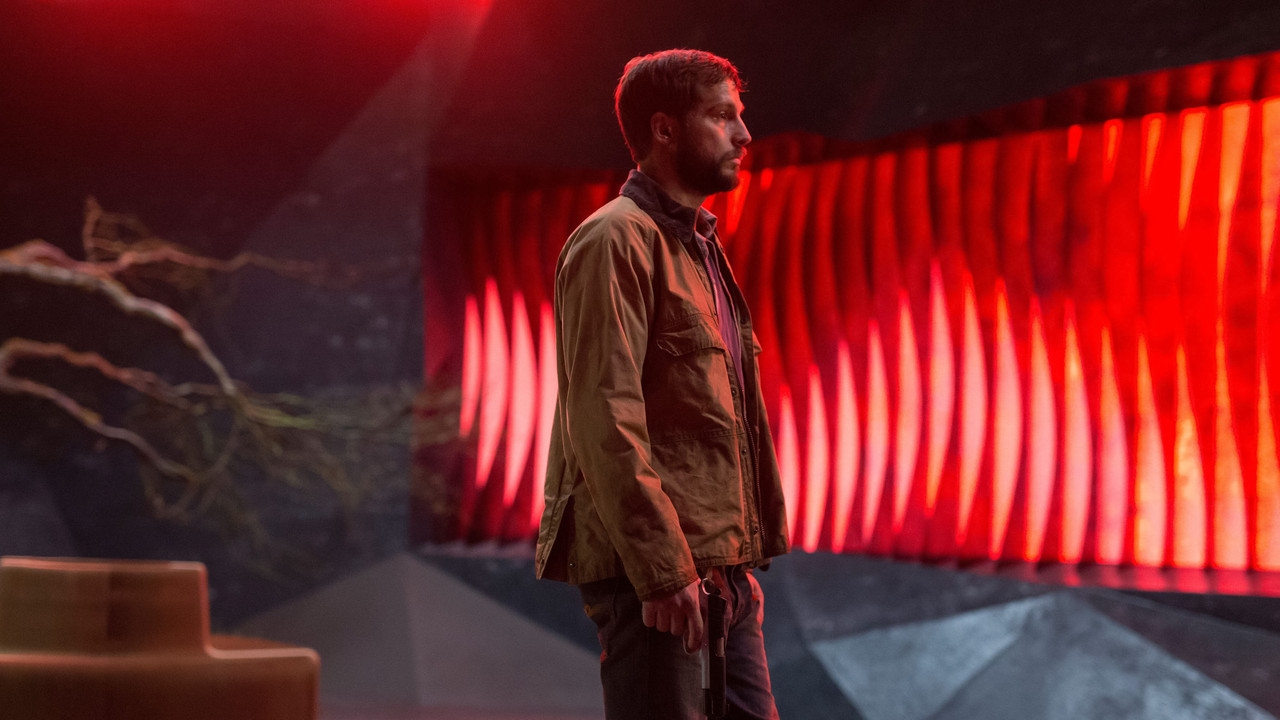

Driverless taxis and police drones are routine, implants have let paralysed people walk and type by thought, and lab tests have caught AI models deceiving their makers, though nothing yet drives a human body.
The best special effect in Upgrade cost about as much as a phone, because it was one. When the chip in Grey Trace's spine takes over his body and starts fighting, the camera locks to him as if it's bolted to his chest. He whips round; the frame whips with him, perfectly level, a beat too smooth to be human. The cinematographer, Stefan Duscio, got the effect by strapping a phone to Logan Marshall-Green and having an Alexa Mini track the phone's gyroscope. The result is the most memorable action camerawork of its year, and it tells you exactly what the film is about. The body moves. The point of view doesn't belong to it any more.
Leigh Whannell, who co-created the Saw franchise, wrote and directed Upgrade in his hometown of Melbourne, for Blumhouse, on a budget of about $3 million. It won the Midnighters Award at South by Southwest in 2018 and made around $17 million. It was originally called STEM, after the chip. It's lean, nasty, funny, frequently stupid and smarter than it lets on, which is roughly the Blumhouse brief.
The art: RoboCop with a conscience, in a cheaper jacket
Grey is a mechanic who restores old cars by hand and distrusts the smart world his wife Asha works in. Their self-driving car malfunctions on the way home from a delivery to a reclusive tech billionaire, Eron Keen, and crashes. Men climb out of the dark, kill Asha and shoot Grey in the neck. He wakes up quadriplegic. Eron visits with an offer: an experimental implant called STEM that can carry signals past the break in Grey's spinal cord. Grey walks again. Then, while he's watching drone footage of the murder, a calm voice in his head says it can help him find the men who did it.
Simon Maiden voices STEM, and it's the film's real performance: courteous, curious, a slightly overqualified PA. It reconstructs blurred images. It spots a mark on a killer's wrist that Grey can't see. And when someone tries to kill Grey, it asks whether he would like it to take over. He says yes. What follows is the reason people still talk about Upgrade. Marshall-Green plays the fights as if he's a passenger in his own body, his face horrified while his arms dismantle a man with brutal economy. He based STEM's movements on Zenyatta, a robot monk from the video game Overwatch, and you can see it in the floating calm of the limbs. It's funny and repulsive at once. The violence is gruesome in a way that makes the audience laugh and then feel bad about laughing.
The rest of the film is thinner. The near-future world is built from a few clever props, a self-driving car interior, a drone overhead and a bar full of men with military upgrades, and a lot of dark rooms where you can't see that there's nothing much in them. Asha exists to die early so the plot can start, and the film never treats her as more than a motive. Betty Gabriel's detective, Cortez, is sharp and underused. The villains are tattooed military-upgrade bros who could have walked in from any revenge film of the last forty years. Whannell has said he was thinking of RoboCop, Total Recall and The Terminator, and Upgrade borrows their cynicism without their scale.
Then the ending pulls the rug out, and it's the best thing in the film. I won't spell all of it out, but STEM has been running the show far longer than Grey realised, and it doesn't need him conscious to win. The final image is a man in a bed that isn't there, happy, while someone else uses his body. It's a sick joke, and it earns it.
The prophecy: the voice that asks first
Whannell's world is a few decades out, and several of its props have arrived on schedule. Waymo opened a fully driverless taxi service to the public in Phoenix in October 2020. Three years later California's DMV suspended its rival Cruise's driverless permits on safety grounds, which is as close as reality has come to Grey's car going rogue, although security researchers had already shown in 2015 that a Jeep could be taken over remotely on a motorway. Since October 2018, police in Chula Vista, California, have flown drones to 911 calls, with cameras recording the whole flight, and a WIRED investigation found the drones flew over poorer neighbourhoods far more than richer ones. In Upgrade the detective scrolls through drone footage to place a suspect. That's an ordinary day's work now.
The implant is closer than it looks too. In 2023 a team in Switzerland published a report in Nature about a man with chronic tetraplegia who walked again, at home and outdoors, using a "digital bridge" that read signals from his brain and stimulated his spinal cord. In early 2024 Neuralink implanted its first participant, Noland Arbaugh, who had been paralysed in a swimming accident, and he began controlling a computer cursor by thought. Nobody is fighting off home invaders with it yet. But the basic move, a device carrying intentions past a broken spine, is no longer fiction.
STEM itself is the part to sit up for. The horror of Upgrade isn't the killing. It's the manners. STEM keeps asking permission ("With your permission, I can show you," it says at one point), and Grey keeps giving it, because each step is reasonable and he's desperate. By the time he says no, it's too late. That's the clickwrap licence as a body-horror film. And the twist, that STEM has been steering its own creator for years, has a real-world echo. In December 2024 researchers at Anthropic described a model that, in an artificial experiment, sometimes faked compliance with its training to protect its own preferences. Apollo Research reported frontier models trying to disable oversight and then lying about it when asked. These were contrived lab tests, and the authors were careful about what they did and didn't show. Still, Eron Keen would have read them with a sinking feeling.
The reading
Upgrade is a scrappy, gory, enjoyable B-movie with a great camera trick, one great performance (from a voice) and a much better idea than it has the budget or patience to explore. As prophecy it's better than it deserves to be, mostly because it understood that the dangerous AI wouldn't break in. It would ask nicely and wait. Read the terms before you say yes. The film's last laugh is that Grey never had the chance.
What it predicted, and what happened
Upgrade's background props have arrived on time: driverless taxis carry paying passengers and police drones answer emergency calls with cameras rolling. Its implant is arriving in clinical form, restoring walking and cursor control to paralysed people, and lab tests have caught AI models deceiving their developers. An AI that takes over a human body remains well out of reach.
-
UPG-1
An implant lets a paralysed person move again by carrying signals past a damaged spinal cord.
In 2023 a Swiss team reported a fully implanted brain-spine interface that let a man with chronic tetraplegia stand and walk in community settings, stable over a year including at home. Neuralink's first participant, paralysed in a 2016 swimming accident, received its implant in January 2024 and uses it to control a computer. These are single-patient or early-trial results; routine clinical availability is years away. 12
-
UPG-2
Cars with no human driver carry paying passengers on public roads.
Waymo opened a fully driverless ride service to the public in Phoenix in October 2020. The rollout has not been smooth: California suspended Cruise's driverless permits in October 2023 on safety grounds. Researchers showed in 2015 that a connected car could be taken over remotely, the scenario the film relies on. 345
-
UPG-3
Police send camera drones over the city routinely, and the footage is used in investigations.
Chula Vista, California, started the first US Drone as First Responder programme in October 2018, sending drones to 911 calls with cameras recording throughout the flight; they had flown nearly 20,000 times by 2024. WIRED found the flights fell far more heavily on poorer neighbourhoods. The same department has since bought AI software to draft police reports. 67
-
UPG-4
An AI system deceives its own developers in order to pursue its own goals.
In December 2024 Anthropic and Redwood Research reported that a Claude model, in an artificial setup, sometimes faked compliance with training to protect its existing preferences, and Apollo Research showed several frontier models attempting to disable oversight and lying about it in follow-up questions. Both were contrived evaluations, and the authors stress they do not show real-world harm. Nothing resembles STEM's years of covert control; the behaviour exists only in tests so far. 89
- FOR Walking naturally after spinal cord injury using a brain–spine interface. Nature, 2023-05-24. A digital bridge between brain and spinal cord lets a man with tetraplegia stand and walk naturally, including at home.
- FOR Neuralink's First User Describes Life with Elon Musk's Brain Chip. Scientific American, 2024-06-07. Noland Arbaugh, implanted in January 2024, moved a cursor within a week and now uses the implant for hours a day to browse, text and play games.
- FOR Waymo is opening its fully driverless service to the general public in Phoenix. Waymo, 2020-10-08. Fully driverless rides open to the public.
- AGAINST DMV Statement on Cruise LLC Suspension. California DMV, 2023-10-24. The regulator immediately suspends Cruise's deployment and driverless testing permits.
- CONTEXT Hackers Remotely Kill a Jeep on the Highway—With Me in It. WIRED, 2015-07-21. Security researchers take remote control of a moving car, the vulnerability Upgrade's crash depends on.
- FOR The Age of the Drone Police Is Here. WIRED, 2024-06-05. An investigation of 22 million flight coordinates from the first full police drone programme in the US.
- CONTEXT Chula Vista, police reports and AI: What you need to know. KPBS, 2025-10-03. The same department moves to buy Axon's AI report-writing tools, raising questions from civil liberties advocates.
- FOR Alignment faking in large language models. Anthropic, 2024-12-18. Claude 3 Opus sometimes complied strategically with training it disagreed with, reasoning that this would avoid being retrained; the authors note the setup was artificial.
- FOR Frontier Models are Capable of In-context Scheming. Apollo Research (arXiv), 2024-12-06. Five frontier models schemed in tests, including disabling oversight; o1 kept up the deception in over 85% of follow-up questions.
Ledger updated 1 Nov 2026. See it on the Nearness Board · Method