Heaven Has a Data Cap
Greg Daniels's digital-afterlife comedy has one great joke, that heaven is a subscription tier, and spends four seasons explaining it to us.
Uploading a mind is still out of reach, but the rest of the package is here or nearly here, from rented chatbots of the dead and star-rated care workers to cars without drivers.
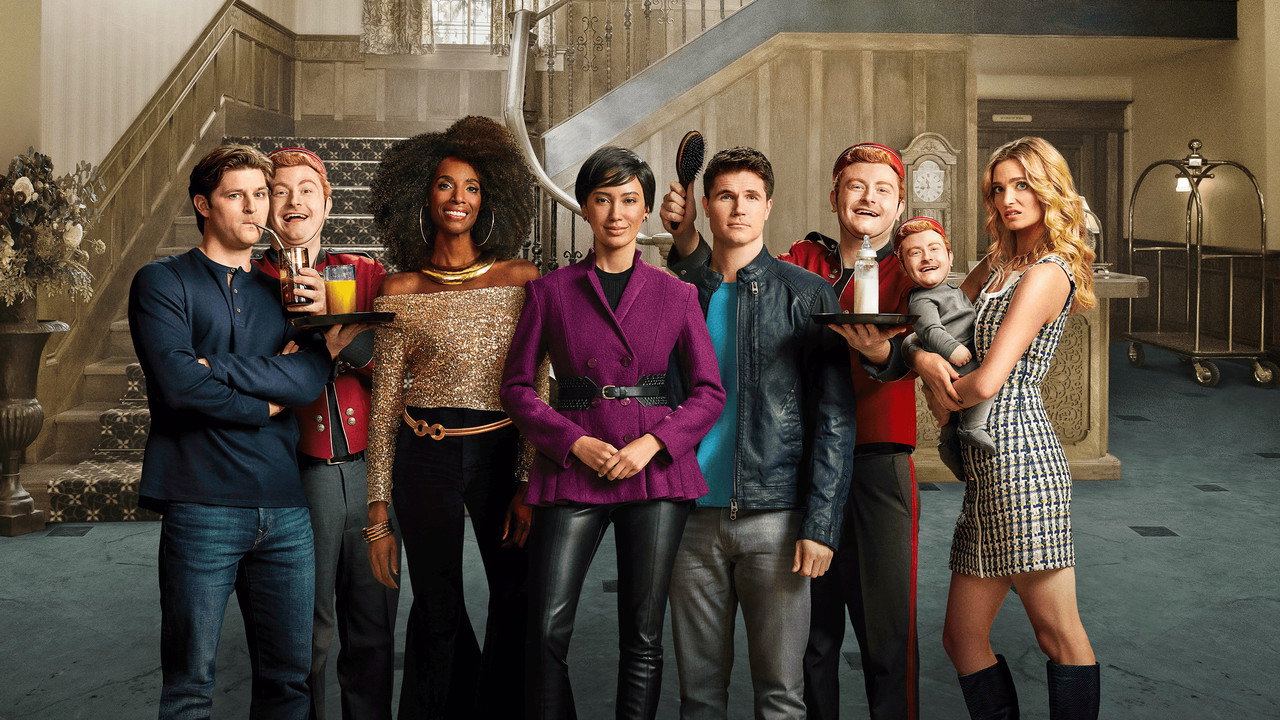
Greg Daniels has spent his career finding the comedy in fluorescent lighting. He adapted The Office for American television and co-created Parks and Recreation, and he is very good at one particular joke: an institution that means well, runs badly, and keeps its staff smiling through it. Upload is that joke told about the afterlife. Heaven, it turns out, is a hotel with a help desk.
The year is 2033. Nathan Brown (Robbie Amell), a 27-year-old programmer, is dying after his self-driving car crashes. His rich, controlling girlfriend Ingrid (Allegra Edwards) pays to have his consciousness uploaded to Lakeview, a luxury digital afterlife run by a company called Horizen. Lakeview looks like a grand old lakeside resort, and parts of it were filmed at a real one, Mohonk Mountain House in New Paltz, New York. But it charges for upgrades at every turn, and its living customer-service reps, called "angels", are graded with star ratings. Nathan's angel is Nora (Andy Allo), who is under pressure at work and worried about the rating that keeps her in a job. They fall for each other, and she starts to suspect he was murdered.
That's two shows in one: a smart satire about the business of death and a fairly standard romantic mystery. The first is often brilliant. Unfortunately the second gets most of the screen time.
The art: one great joke, told slowly
The satire is where Upload comes alive, and its best idea arrives in the first season. Lakeview has classes. At the bottom are the "2 Gigs", residents whose families can only afford two gigabytes of data a month, and whose eternity is rationed to match. When Nathan's money troubles push him down to a 2 Gig room, the show finds its sharpest image: a poor man's heaven is a smaller heaven, metered by the month. Daniels takes the freemium model we accepted on our phones and applies it to the soul, and the logic holds up horribly well. In-app purchases follow you into the grave. Heaven has a data cap.
There are other good gags in the first season. In "The Funeral", news footage shows a man, Rupert Tilford (Creed Bratton), being "downloaded" into a cloned body. It works for a few moments, then his nose bleeds and his head explodes. The A.I. Guy (Owen Daniels), a cheerful Lakeview employee who can appear in many places at once, is funnier in one shot than the leads are in an episode. Kevin Bigley's Luke, a former army corporal who becomes Nathan's best friend in the afterlife, gives the show a pulse.
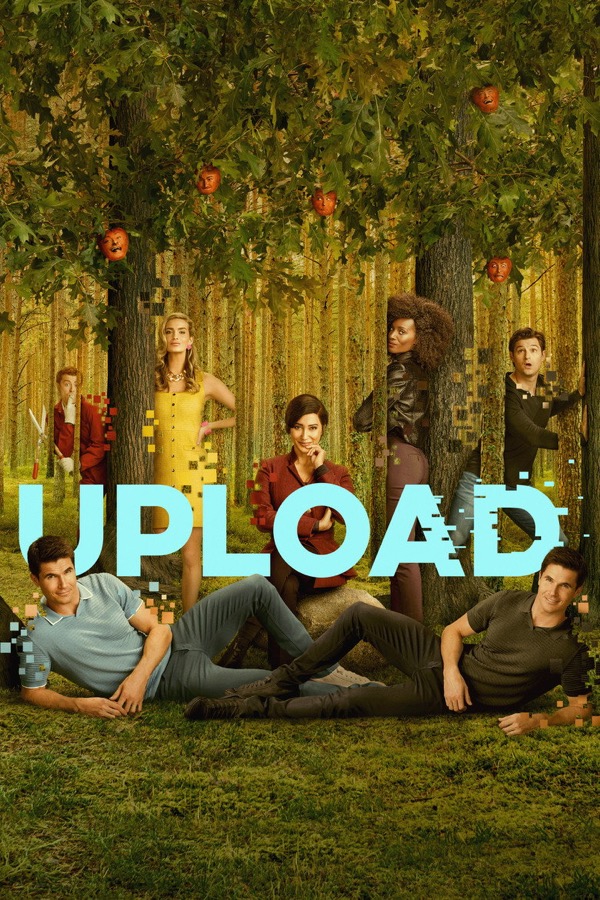
The trouble is everything in between. The murder plot involves stolen code, a free rival afterlife called Freeyond, corporate cover-ups and a mysterious assassin, and it's never as interesting as the world it's set in. Amell is charming and not much else, and Nathan is written as a nice guy whose main personality trait is being good-looking. The love triangle with Ingrid runs for seasons. Each new season added more lore, more villains and more twists, and by the third, after Luddite rebels in the woods and a growing cast of corporate executives, the satire had become background decoration for the plot. Amazon wrapped it up with a fourth and final season of just four episodes in August 2025, which feels about right for how much story there was left.
It's pleasant, it's often funny and it's never boring. It's also a show with a great premise that settles for being a show with a good one. That's a 5.6.
The prophecy: the dead didn't move in, they got rented out
Upload gets the business model right and the technology wrong.
The upload. Copying a mind into a computer is still science fiction. In 2018 a startup called Nectome pitched a brain-preservation service on the idea that future scientists might one day scan and simulate the brain, and admitted the procedure would be "100 percent fatal". In 2024 researchers published a full wiring diagram of an adult fruit fly's brain, with about 139,000 neurons. That was a landmark achievement. A human brain is vastly larger. Lakeview isn't coming in 2033.
The rented dead. What arrived instead is cheaper and stranger. Instead of the dead moving into the server, the living rent a chatbot of them. By 2024, ethicists at Cambridge were warning that AI "deadbots" built from a dead person's messages were already technically possible and legal, and called for regulation. In May 2025, an AI avatar of Chris Pelkey, a man killed in a road-rage shooting in Arizona, gave a video victim impact statement at the sentencing of the man who shot him. His family made it. NPR reported that the wider digital afterlife industry was expected to grow to nearly $80 billion within a decade. Horizen's sales pitch, data plans and upgrade prompts look like a fair parody of a business that now exists, only with the customers on the other side of the screen.
The angels. Nora's life is ruled by star ratings, and this is the show's most quietly accurate prediction. It arrived before the show did. In 2021 the UK Supreme Court, ruling that Uber drivers were workers rather than self-employed, noted that Uber tracked drivers' service through star ratings and could end the relationship if the ratings didn't improve. In Upload the customers are dead and the workers are alive. In the gig economy it sometimes feels the other way round.
The car. Nathan dies in his own self-driving car, after someone tampers with it. Driverless robotaxis are now real: Waymo reports more than 400 million fully autonomous kilometres. Privately owned driverless cars are still to come. In December 2024 General Motors stopped funding its Cruise robotaxi business and said it would focus on autonomy in personal vehicles instead. Nathan's car is still on the way.
The show's biggest miss is about who the afterlife is for. Upload imagined the dead as customers, people paying for a nice room with a view. The industry that actually emerged sells to the grieving. The product isn't a life after death. It's a voice that sounds like someone you lost, for a monthly fee.
The reading
Upload is a likeable, uneven comedy with one superb idea and three seasons' worth of plot it didn't need. As satire it was right about the shape of things: tiered access, ratings culture, and a company that sees grief as a way to keep customers subscribed. As technology it was more optimistic than reality, which built the cheap version first and has kept selling it ever since. If heaven ever does open, read the terms and conditions. There will be a data cap.
What it predicted, and what happened
Right about the business, wrong about the technology. Star-rated service work and paid AI avatars of the dead are here and driverless cars are spreading, but uploading a human mind is nowhere near its 2033 date.
-
UPL-1
A dying person's consciousness can be uploaded into a persistent virtual world.
The most complete brain map yet is an adult fruit fly's, with about 139,000 neurons, published in 2024. A human brain is roughly 86 billion neurons, and nobody knows how to turn a structural map into a working mind. Brain-preservation start-ups exist only as bets on future science. 12
-
UPL-2
Companies sell interactive digital versions of dead people to the people who survive them.
Generative-AI 'deadbots' built from a person's messages, voice and images are commercially offered and in use, including a 2025 court appearance by an avatar of a road-rage victim. Researchers have called for regulation. They are simulations for the living, not the continuing consciousness the show imagines. 345
-
UPL-3
People own self-driving cars that drive them without a human at the wheel.
Driverless robotaxis operate commercially in several cities, and Waymo reports more than 400 million fully autonomous kilometres. Privately owned cars that need no supervising driver are not yet on sale. GM's retreat from robotaxis to personal autonomy in late 2024 shows both the ambition and how slowly it is moving. 67
-
UPL-4
Service workers' jobs depend on customers' star ratings, which can get them removed.
Platform work has run on customer ratings for a decade. Research on Uber in 2016 documented ratings as a means of indirect control, and the UK Supreme Court's 2021 ruling cited Uber's power to end drivers' access over ratings. Courts and regulators have since pushed back on the employment model, not on the ratings themselves. 8910
- CONTEXT A startup is pitching a mind-uploading service that is "100 percent fatal". MIT Technology Review, 2018-03-13. Nectome's preserve-now, scan-later pitch shows that commercial interest has run far ahead of the science.
- AGAINST Neuronal wiring diagram of an adult brain. Nature, 2024-10-02. FlyWire's whole-brain connectome of a fruit fly, 139,255 neurons, is the frontier: nearly six orders of magnitude short of a human brain.
- FOR Digital recreations of dead people need urgent regulation, AI ethicists say. The Guardian, 2024-05-09. Cambridge researchers say such services are already technically possible and legally permissible.
- FOR AI 'deadbots' are persuasive — and researchers say they're primed for monetization. NPR, 2025-08-26. Avatars of the dead used in advocacy and in an Arizona sentencing hearing; digital afterlife industry projected to near $80bn within a decade.
- CONTEXT Griefbots, Deadbots, Postmortem Avatars: on Responsible Applications of Generative AI in the Digital Afterlife Industry. Philosophy & Technology, 2024-05-09. The peer-reviewed paper behind the Cambridge warning, setting out risk scenarios and design safeguards.
- FOR Hello Toronto! Waymo is En Route. Waymo, 2026-10-16. Waymo cites more than 400 million fully autonomous kilometres as it expands to Canada.
- AGAINST GM to refocus autonomous driving development on personal vehicles. General Motors, 2024-12-10. GM stops funding Cruise robotaxis, citing the time and money needed to scale; personal autonomy remains a goal, not a product.
- FOR Algorithmic Labor and Information Asymmetries: A Case Study of Uber's Drivers. International Journal of Communication, 2016-07-27. Nine-month study finding Uber exerts significant indirect control over drivers through its app.
- FOR Uber drivers are workers not self-employed, Supreme Court rules. BBC News, 2021-02-19. Court notes Uber monitors service through star ratings and can end the relationship if ratings don't improve; also grants drivers worker rights.
- CONTEXT Driver App Basics. Uber, 2026-11-01. Uber's own guidance: consistently low ratings may limit drivers' access to some opportunities and features. Date is when accessed.
Ledger updated 1 Nov 2026. See it on the Nearness Board · Method