Everything Happened, Nobody Decided
Russell T Davies's six-hour family saga got the headlines of the 2020s uncomfortably right, because it was never really about the headlines.
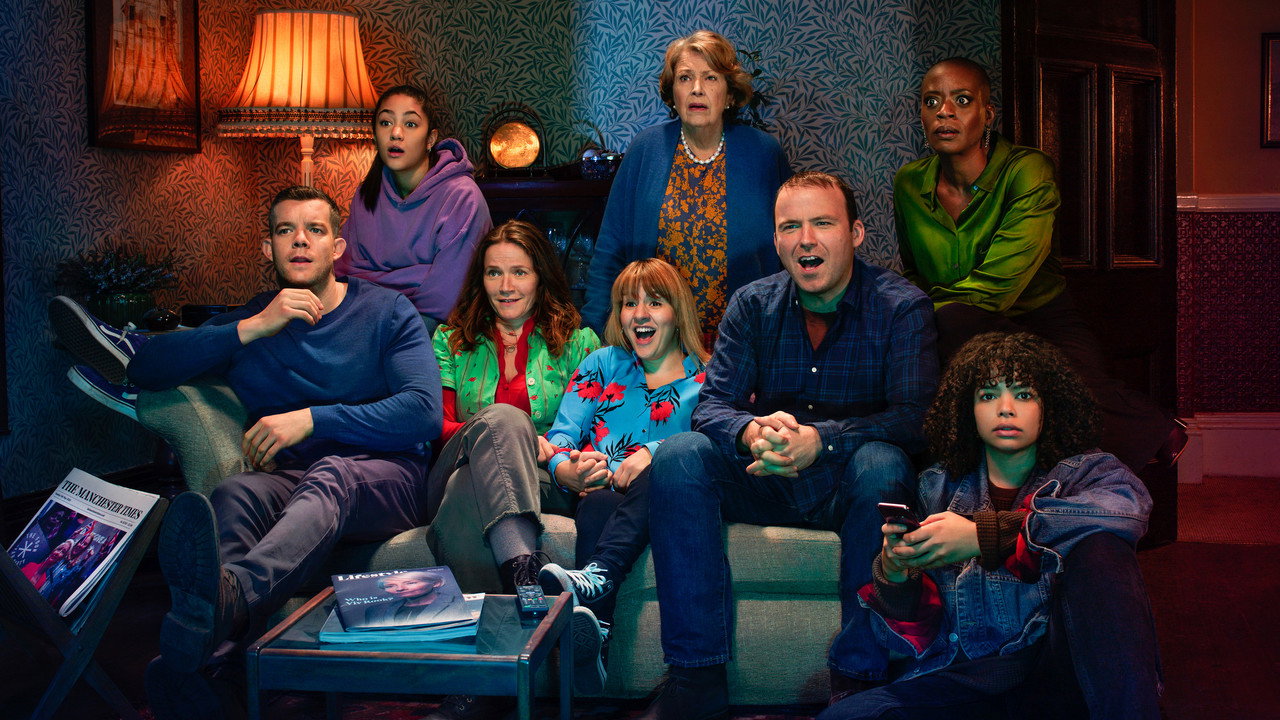
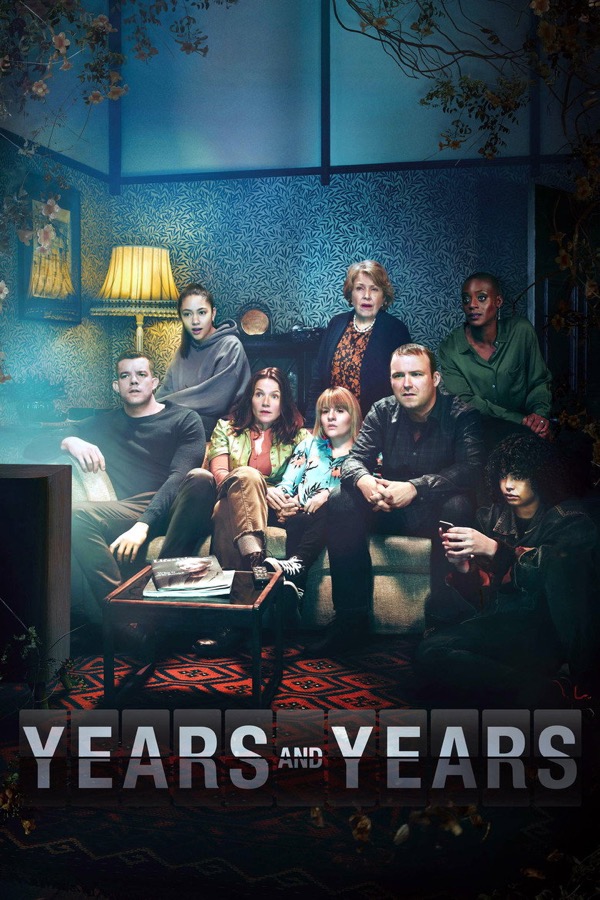
Trump's second term, Ukrainian refugees and an American bank collapse all turned up roughly on schedule, while the strongwoman prime minister, the camps and the brain-wired teenager are still only possibilities.
On 5 October 2022, Liz Truss walked on stage at the Conservative party conference in a Karen Millen dress with puffed sleeves. People soon noticed that it was the same dress Emma Thompson wears as Vivienne Rook, the populist prime minister in Years and Years. Russell T Davies posted the two pictures side by side on Instagram with a four-word caption: "This is getting weird."
It wasn't a tribute. Truss had worn the dress at an event back in 2019. But that's how Years and Years has been living since it aired. It keeps being right about things by accident, because Davies was paying attention to the present.
The series ran in six hour-long episodes on BBC One from May 2019, then on HBO that June. It follows one Manchester family, the Lyons, from 2019 to 2034. There's Stephen (Rory Kinnear), a financial adviser; his wife Celeste (T'Nia Miller); Daniel (Russell Tovey), a housing officer; Rosie (Ruth Madeley), a single mother with spina bifida who works in a school canteen; Edith (Jessica Hynes), an activist who's always somewhere dangerous; and their grandmother Muriel (Anne Reid), who presides over the lot of them from a crumbling house. In the background, and sometimes the foreground, is Rook. She's a businesswoman who swears on Question Time about Israel and Palestine and builds a party, the Four Star Party, named after the asterisks the broadcasters used to bleep her.
The art: the future arrives in the kitchen
The best decision Davies made was formal. Each episode jumps forward a year or more, and the big events reach the family the way they reach real families: through a phone notification, a radio left on in the next room, a row at a birthday party. A nuclear strike is something the Lyons hear about at Muriel's 92nd birthday. A bank collapse is a hole, overnight, where the money from a house sale used to be. That's what it felt like to live through the late 2010s and the 2020s: history as weather, always on, never quite your business until it suddenly is.
The cast makes it work. Kinnear plays Stephen as a decent man who becomes something worse when he loses his status, and you can watch the moment it happens. Tovey gets the show's biggest arc. Daniel leaves his husband for Viktor (Maxim Baldry), a gay Ukrainian refugee. Then he loses Viktor to deportation, follows him to Madrid, and drowns in the Channel in an overcrowded boat. That scene in the fourth episode is the best and hardest thing in the series, and it offers no comfort at all. Reid's Muriel is the comic engine and, by the end, the moral one. In the finale she gives her family a speech that one reviewer called "an articulate kick up our collective backside": a monologue saying the mess is everyone's fault, built from all the small daily choices that nobody thought counted.
Thompson is terrific and there isn't enough of her. Rook is mostly a face on a screen, which is the point, but it means the show's most frightening idea, that a celebrity can talk her way into power by saying the rude thing out loud, is sketched rather than shown working.
Davies's habits are on full display. He loves a speech, and the characters deliver them in the middle of family dinners. Bethany (Lydia West), the teenage daughter who declares herself transhuman and gets hand implants and later a brain implant, is the weakest strand. She's a walking idea about technology who keeps turning up when the plot needs a hacker. The last episode settles everything too tidily. Rosie drives her van through a curfew fence on live television, Rook is charged with murder over the "Erstwhile" camps, the BBC comes back on air and the family gathers round. After five hours of watching small decencies lose to big indifference, the show lets one van and a broadcast win. It's moving. It isn't believable. That's what keeps it at 7.6.
The prophecy: the forecast was the family
It's easy to make a list of what Years and Years got right, and the list is unnerving.
Trump comes back. The show gives Donald Trump a second term, then has him fire a nuclear missile at Hong Sha Dao, an artificial island China has built in disputed waters. The real second term began in January 2025, after a gap the show didn't predict, and nobody has fired a nuclear weapon. But China really has spent the years since 2013 dredging thousands of acres of new land out of the South China Sea. Davies didn't have to invent the island. He only had to imagine what someone might do to it.
Ukraine. In the show, a Russian-backed government takes over Ukraine, gay Ukrainians are persecuted, and refugees like Viktor end up in camps run by people like Daniel. In 2022 Russia invaded Ukraine in full, and millions of Ukrainians fled west, many of them to Britain under visa schemes created for them. Kyiv didn't fall, so the details are wrong. But in 2019, Ukrainian refugees were not an obvious thing to put in a Manchester family drama.
The bank. In the second episode an American bank collapses, the crisis spreads, and Stephen and Celeste lose the money from their house sale overnight. In March 2023 Silicon Valley Bank collapsed and panic did spread across the Atlantic. Then the states stepped in. Washington promised that every depositor would be made whole, and HSBC bought SVB's British arm within days. The show predicted the shock correctly but not the bailout, and the gap between the two is where most real lives happen.
The job. Celeste, an accountant, loses her job to AI in 2025. That's the forecast everyone now makes. The evidence so far is mixed. The IMF estimated in early 2024 that about 40 per cent of jobs worldwide were exposed to AI. A Yale Budget Lab study in October 2025 found no sign yet of a broad disruption to the labour market.
What Davies really predicted, though, wasn't any single event. It was the feeling of the 2020s. A disaster happens, then the next one happens before you've finished reacting to the first, and the main cost is exhaustion. The show is clear about who wins in that kind of country. People who have learned to stop paying attention leave room for someone like Rook to get her way. Muriel's speech makes the same point. In a country like that, nobody votes for the catastrophe. They just never get round to voting against it.
He missed some things. Rook's Britain turns authoritarian through Parliament and the camps, the old-fashioned way. The real drift of the 2020s has been less dramatic and harder to film: power moving to platforms, to feeds and to people who never stand for anything. And the show's transhumanism, for all of Bethany's screen time, turned out to be its most dated idea. The machines that actually changed family life in the 2020s were chatbots on phones. Nobody needed an implant in their eye.
The reading
Years and Years is a big-hearted, over-talkative, often brilliant family drama that went on to look like a documentary. Its prophecy is unusually good because it isn't really prophecy. Davies took the anxieties of 2019 seriously, gave them faces, and moved them a few years down the road. If he was right, he was right the way a good doctor is: he had read the symptoms. The show's best line of argument is also its saddest. In the Lyons' Britain, everything happened, and nobody decided.
What it predicted, and what happened
Unusually prescient on events: a second Trump term, Ukrainian refugees and a US bank collapse that rattled Britain all arrived within a few years of the show's dates. It was wrong about the outcomes, because states rescued depositors and Kyiv did not fall, and its forecast that AI would take office jobs is still unproven.
-
YAY-1
Donald Trump serves a second term as US president.
The show gives Trump a consecutive second term ending in a nuclear strike on a Chinese artificial island. In reality he lost in 2020, won in 2024 and began a non-consecutive second term in January 2025. China's island-building in the South China Sea, which the show extrapolates, is real; the strike is not. 12
-
YAY-2
Russian aggression against Ukraine drives large numbers of Ukrainian refugees into Western Europe and Britain.
Russia's full-scale invasion in February 2022 sent millions of Ukrainians west as refugees, and Britain created dedicated visa schemes. The show's detail, a Russian-backed regime in Kyiv persecuting gay people, did not happen. 34
-
YAY-3
Office professionals such as accountants lose their jobs to AI in large numbers by the mid-2020s.
Exposure is high on paper: the IMF estimated in 2024 that almost 40 per cent of global employment is exposed to AI. Measured disruption is not yet visible. A Yale Budget Lab analysis in October 2025 found no discernible economy-wide effect since ChatGPT's release. Partial, occupation-level effects make this ARRIVING rather than ARRIVED. 56
-
YAY-4
The collapse of a US bank sets off a crisis in which ordinary British savers lose their deposits overnight.
The trigger arrived almost exactly: Silicon Valley Bank failed in March 2023 and the shock reached British firms within days. The outcome went the other way. US authorities guaranteed depositors and the UK arm was sold to HSBC with customers' money intact. The precedent now is rescue, not loss. 78
- FOR President Donald J. Trump. The White House, 2026-11-01. Official biography of the 45th and 47th President. Date is when accessed.
- CONTEXT China Tracker. Asia Maritime Transparency Initiative, CSIS, 2026-11-01. Since 2013 China has created 5,460 acres of new land in the Spratlys and Paracels, the real basis for the show's Hong Sha Dao. Date is when accessed.
- FOR Ukraine Refugee Situation. UNHCR Operational Data Portal, 2026-11-01. UNHCR's running record of refugees from Ukraine across Europe. Date is when accessed.
- FOR Ukraine Visa Schemes: visa data. UK Home Office (GOV.UK), 2024-12-19. Data on the UK's Ukraine Family and Sponsorship schemes; weekly publication ended in December 2024.
- FOR AI Will Transform the Global Economy. Let's Make Sure It Benefits Humanity.. International Monetary Fund, 2024-01-14. Kristalina Georgieva: almost 40 per cent of global employment, and about 60 per cent in advanced economies, is exposed to AI.
- AGAINST Evaluating the Impact of AI on the Labor Market: Current State of Affairs. The Budget Lab at Yale, 2025-10-01. Finds no discernible disruption to the broader US labour market in the 33 months after ChatGPT's release.
- CONTEXT Joint Statement by Treasury, Federal Reserve, and FDIC. Board of Governors of the Federal Reserve System, 2023-03-12. Emergency action after SVB's failure; states that depositors will be made whole with no losses to taxpayers.
- AGAINST HSBC swoops in to rescue UK arm of Silicon Valley Bank. BBC News, 2023-03-13. Government and Bank of England broker a sale that lets UK customers access their money as normal.
Ledger updated 1 Nov 2026. See it on the Nearness Board · Method